GENERAL STEPS: To a three-necked round-bottomed flask cooled in an ice-water bath was added an anhydrous tetrahydrofuran (THF, 10 mL) solution of triphenylphosphine (Ph3P, 0.015 mol), followed by an anhydrous THF (10 mL) solution of 3-cyclopenten-1-ol (II, 0.012 mol) and an anhydrous THF (0.015 mol) solution of N-Boc-ethyl oxalate ( 10 mL) solution. Diethyl azodicarboxylate (DEAD, 0.015 mol) was slowly added dropwise to the above mixture. The reaction mixture was stirred at 0°C for 2 hours, followed by continuing the reaction at room temperature for 48 hours. Upon completion of the reaction, the solvent was removed by reduced pressure distillation and the residue was dissolved in dichloromethane (CH2Cl2, 30 mL) and washed sequentially with water and brine (20 mL x 3). The solvent was again removed by reduced pressure distillation and the residue was purified by column chromatography (silica gel, 100% dichloromethane) to afford a mixture of ethyl (tert-butoxycarbonyl-cyclopent-3-enyl-amino)-oxo-acetate and N-Boc-ethylcarbamate, which was used for the next reaction without further purification. The above crude product (3.80 g) was dissolved in THF (35 mL), cooled in an ice-water bath and stirred, and a solution of lithium hydroxide (LiOH, 0.0765 mol) in water (35 mL) was slowly added. The mixture was continued to be stirred in an ice-water bath for 3 hours. Upon completion of the reaction, the organic material was extracted with dichloromethane (30 mL x 3), the organic layers were combined and washed with brine (30 mL x 2), and the solvent was subsequently removed by distillation under reduced pressure. The residue was purified by column chromatography (silica gel, 100% dichloromethane) to give white crystals of the pure product in 53% yield.

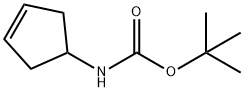

![Acetic acid, 2-[3-cyclopenten-1-yl[(1,1-dimethylethoxy)carbonyl]amino]-2-oxo-, ethyl ester](/CAS/20210305/GIF/1018908-86-5.gif)
