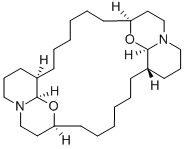
Description
Xestospongin C (88903-69-9) is a potent and reversible inhibitor of IP3-mediated Ca2+release, IC50= 358 nM.1Experiments with guinea-pig ileum permeabilized with alpha toxin revealed that Xestospongin C inhibits the IP3 receptor but not the ryanodine receptor in SR membranes. In intact smooth muscle cells it inhibits voltage-dependent Ca2+and K+currents at a concentration range similar to that at which it inhibits the IP3 receptor. Xestospongin C is a useful tool for probing the involvement of IP3 receptors in cellular signaling.3Cell permeable.
Uses
Xestospongin C is a potent, membrane-permeable IP3 receptor blocker.
Uses
Xestospongin C is a marine natural product which was first isolated from Pacific basin sponges, and noted to have vasodilatory properties. Xestospongin C antagonizes the calcium-releasing action of inositol-1,4,5-trisphosphate (IP3) at the receptor level. Inositol phosphates are important signal transduction messengers acting via IP3 receptors to promote the mobilization of Ca2+ from intracellular stores. Xestospongin C blocks the increase in intracellular calcium in vascular smooth muscle cells completely at a concentration of 25 μM. Xestospongin C also inhibits the sarcoplasmic reticulum Ca2+ ATPase pump at concentrations of 700 nM.
Definition
ChEBI: An organic heteropentacyclic compound that is isolated from the marine sponge Xestospongia exigua.
General Description
Synthetic form of the macrocyclic bis-1-oxaquinolizidine isolated from the Okanowan marine sponge.
Biochem/physiol Actions
Xestospongin C is a selective, reversible and membrane-permeable inhibitor of IP3 receptor. Reversibly blocks bradykinin- and carbamylcholine- Ca2+ efflux from the endoplasmic reticulum stores.
References
[1] R A WILCOX. New developments in the molecular pharmacology of the myo-inositol 1,4,5-trisphosphate receptor.[J]. Trends in pharmacological sciences, 1998, 19 11: 467-475. DOI:
10.1016/s0165-6147(98)01260-7[2] HIROSHI OZAKI. Inhibitory mechanism of xestospongin-C on contraction and ion channels in the intestinal smooth muscle[J]. British Journal of Pharmacology, 2009, 137 8: 1207-1212. DOI:
10.1038/sj.bjp.0704988[3] KATHIRVEL KANDASAMY. Lipopolysaccharide induces endoplasmic store Ca2+-dependent inflammatory responses in lung microvessels.[J]. PLoS ONE, 2013: e63465. DOI:
10.1371/journal.pone.0063465