Description
12(S)-
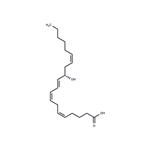
HETE is the predominant lipoxygenase product of mammalian platelets. It enhances tumor cell adhesion to endothelial cells, fibronectin, and the subendothelial matrix at 0.1 μM.
12(S)-HETE MaxSpec
® standard is a quantitative grade standard of 12(S)-HETE that has been prepared specifically for mass spectrometry or any application where quantitative reproducibility is required. The solution has been prepared gravimetrically and is supplied in a deactivated glass ampule sealed under argon. The concentration was verified by comparison to an independently prepared calibration standard. This 12(S)-HETE MaxSpec
® standard is guaranteed to meet identity, purity, stability, and concentration specifications and is provided with a batch-specific certificate of analysis. Ongoing stability testing is performed to ensure the concentration remains accurate throughout the shelf life of the product.
Note: The amount of solution added to the vial is in excess of the listed amount. Therefore, it is necessary to accurately measure volumes for preparation of calibration standards. Follow recommended storage and handling conditions to maintain product quality.
Biochem/physiol Actions
12(S)-HETE is a bioactive lipid implicated in angiogenesis, growth, and metastasic action in tumor cell lines and in animal models. Arachidonate 12-lipoxygenase (12-LOX) converts arachidonic acid to 12(S)-(HETE). Alteration in 12-LOX expression or activity has been reported in various carcinomas including prostate carcinoma.
References
[1] M HAMBERG B S. Prostaglandin endoperoxides. Novel transformations of arachidonic acid in human platelets.[J]. Proceedings of the National Academy of Sciences of the United States of America, 1974, 71 9: 3400-3404. DOI:
10.1073/pnas.71.9.3400[2] I M GROSSI. Bidirectional control of membrane expression and/or activation of the tumor cell IRGpIIb/IIIa receptor and tumor cell adhesion by lipoxygenase products of arachidonic acid and linoleic acid.[J]. Cancer research, 1989, 49 4: 1029-1037.
[3] K.V. HONN . Fatty acid modulation of tumor cell adhesion to microvessel endothelium and experimental metastasis[J]. Prostaglandins, 1992, 44 5: Pages 413-429. DOI:
10.1016/0090-6980(92)90137-i[4] MARIYA MISHEVA. Oxylipin metabolism is controlled by mitochondrial β-oxidation during bacterial inflammation[J]. Nature Communications, 2020, 1 1. DOI:
10.1101/2020.08.17.252007[5] SWATHI BANTHIYA . Structural and functional basis of phospholipid oxygenase activity of bacterial lipoxygenase from Pseudomonas aeruginosa[J]. Biochimica et biophysica acta. Molecular and cell biology of lipids, 2016, 1861 11: Pages 1681-1692. DOI:
10.1016/j.bbalip.2016.08.002[6] KENNETH V. HONN. 12-HETER1/GPR31, a high-affinity 12(S)-hydroxyeicosatetraenoic acid receptor, is significantly up-regulated in prostate cancer and plays a critical role in prostate cancer progression[J]. FASEB Journal, 2016, 30 6: 2360-2369. DOI:
10.1096/fj.201500076[7] AI SASAKI. Determination of ω-6 and ω-3 PUFA metabolites in human urine samples using UPLC/MS/MS[J]. Analytical and Bioanalytical Chemistry, 2015, 407 6: 1625-1639. DOI:
10.1007/s00216-014-8412-5[8] CLAUDE CHAVIS . A Method for the Measurement of Plasma Hydroxyeicosatetraenoic Acid Levels[J]. Analytical biochemistry, 1999, 271 1: Pages 105-108. DOI:
10.1006/abio.1999.4113[9] C V RAO. Chemoprevention of colon carcinogenesis by phenylethyl-3-methylcaffeate.[J]. Cancer research, 1995, 55 11: 2310-2315.