Biological Activity
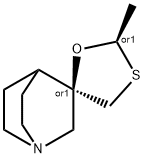
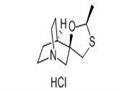
cevimeline is a muscarinic receptor agonist especially on the m1 and m3 receptors. [1]cevimeline has been approved for use against symptoms of dry mouth by activating the m3 receptors of the parasympathetic nervous system. cevimeline is effective and safe in improving symptoms of dry eye with 20 mg three times per day [2]. cevimeline increased the intracellular ca+ level in parotid gland acinar cells over 1 μm and rat, enhanced the excitability via muscarinic receptors, thereby, cevimeline alleviates dry mouth symptoms by stimulating secretion by the salivary glands. cevimeline has a longer duration of salivation[3]. cevimeline plays a part in alzheimer’s disease. cevimeline decreased aβ (1–40) level in the cerebrospinal fluid (csf) at 1 mg/kg without changing α-apps in rabbit and significantly decreased csf aβ in ad patients.[4]
Synthesis
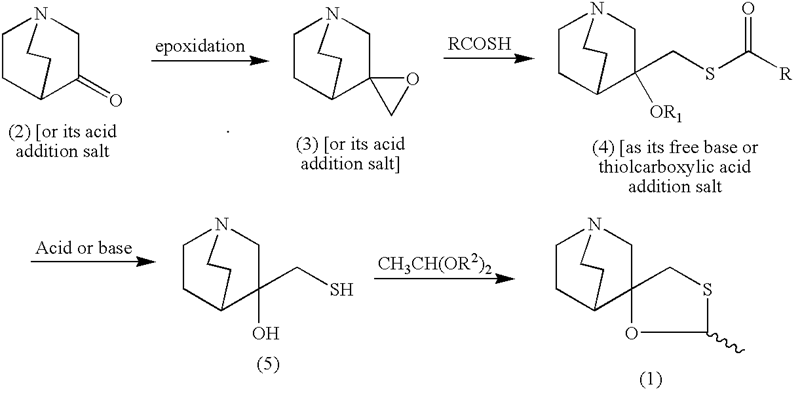
The synthesis of cevimeline commences with the epoxidation of the starting material 3-quinuclidinone (2) to yield the intermediate epoxide of 3-methylenequinuclidine (3). This reacts with thiol carboxylic acid RCOSH to form compound (4), which is subsequently converted to the intermediate 3-hydroxy-3-mercaptomethylquinuclidine (5) in the presence of acid or base. and finally purified via a one-pot process.
References
1. f. b. vivino, i. al-hashimi, z. khan, f. g. leveque, p. l. salisbury, 3rd, t. k. tran-johnson, c. c. muscoplat, m. trivedi, b. goldlust and s. c. gallagher, arch intern med 1999, 159, 174-181. 2. m. ono, e. takamura, k. shinozaki, t. tsumura, t. hamano, y. yagi and k. tsubota, am j ophthalmol 2004, 138, 6-17. 3. k. ono, t. inagaki, t. iida, r. hosokawa and k. inenaga, j med invest 2009, 56 suppl, 375. 4. a. fisher, z. pittel, r. haring, n. bar-ner, m. kliger-spatz, n. natan, i. egozi, h. sonego, i. marcovitch and r. brandeis, j mol neurosci 2003, 20, 349-356.