Uses
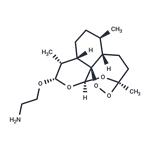
β-Aminoarteether (SM934 free base) is an Artemisinin derivative with orally active. β-Aminoarteether can be used for inflammation and autoimmune disease research, such as lupus diseases[1].
Definition
ChEBI: Beta-aminoarteether is an artemisinin derivative in which the lactone of (+)-artemisinin has been converted into the corresponding lactol 2-aminoethyl ether [beta (S) configuration at the new stereocentre]. It is an artemisinin derivative and a primary amino compound.
in vivo
β-Aminoarteether (SM934; 1-10 mg/kg; oral administration; daliy; for 3 months) treatment significantly delays the progression of glomerulonephritis and increases the survival rate of NZB/W F1 mice. β-Aminoarteether treatment promots the IL-10 production of macrophages from NZB/W F1 mice[1].
| Animal Model: | Female NZB/W F1 mice (Six and half months old)[1] |
| Dosage: | 1 mg/kg, 3 mg/kg, and 10 mg/kg |
| Administration: | Oral administration; daliy; for 3 months |
| Result: | Significantly delayed the progression of glomerulonephritis and increased the survival rate of NZB/W F1 mice. |
References
[1] Li-Fei Hou, et al. SM934 treated lupus-prone NZB × NZW F1 mice by enhancing macrophage interleukin-10 production and suppressing pathogenic T cell development. PLoS One. 2012;7(2):e32424. DOI:
10.1371/journal.pone.0032424[2] Yang FM, Fan D, Yang XQ, et al. The artemisinin analog SM934 alleviates dry eye disease in rodent models by regulating TLR4/NF-κB/NLRP3 signaling. Acta Pharmacol Sin. 2021;42(4):593-603. DOI:
10.1038/s41401-020-0484-5

![Ethanamine, 2-[[(3R,5aS,6R,8aS,9R,10S,12R,12aR)-decahydro-3,6,9-trimethyl-3,12-epoxy-12H-pyrano[4,3-j]-1,2-benzodioxepin-10-yl]oxy]- Structure](https://www.chemicalbook.com/CAS/20210111/GIF/133162-24-0.gif)