Description
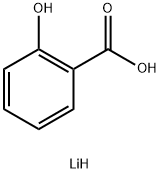
Lithium salicylate is the lithium salt of salicylate, which is a kind of organic acid. Lithium salicylate may be a good alternative for treating bipolar disorder and other neuropsychiatric conditions as it was recently found that oral lithium salicylate was able to produce steady lithium levels for up to 48 hours in rats – without the toxic side effects typically linked with the rapid absorption of current FDA-approved lithium carbonate. It is also proposed that lithium salicylate is most effective drug in reducing self-harm and suicide.
The therapeutic effect of lithium salicylate allows for its application in diuretics. In addition, with the aid of its catalysis effect, this chemical can be employed as the catalysts for chemiluminescent system or trimer catalyst for aliphatic and aromatic isocyanates.
Sources
https://www.redorbit.com/news/health/1113093183/biploar-disorder-lithium-therapy-sodium-based-better-031214/
https://www.theguardian.com/society/2016/aug/14/lithium-should-be-more-widely-used-for-bipolar-disorder-researchers-say
https://www.sdrugs.com/?c=drug&s=lithium%20salicylate
Junquera, E.; Pena, L.; Aicart, E., Binding of sodium salicylate by beta-cyclodextrin or 2,6-di-O-methyl-beta-cyclodextrin in aqueous solution. J. Pharm. Sci. 1998, 87, 86-90.
Herbert, P. R.; Joseph, H. J., Chemiluminescent system catalysts. United Sates Patent 4626383 1986.
W.E., S.; H.T., K.; T., H., Trimer catalyst for aliphatic and aromatic isocyanates. United Sates Patent 5905151 1999.
Chemical Properties
Lithium salicylate, chemical formula LiL7H5O3, molecular weight 144.06, white powdery solid. Hygroscopicity. Soluble in water and ethanol. Decomposed by heat. Stable in aqueous solution and does not decompose when heated. Slightly alkaline in aqueous solution. Monohydrate is a colorless crystal that emits a lavender fluorescence of about 3.650×10⁻⁷m.
Purification Methods
Recrystallise it from EtOH (2mL/g) by partial evaporation. [Beilstein 10 H 59, 10 II 32, 10 III 93, 10 IV 126.]