Application
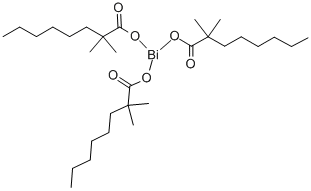
Bismuth neodecanoate can be used as a catalyst to synthesize:
Thermoplastic polyurethanes by reacting polycaprolactone diols, diisocyanates, and diols with anthracene group.
Polysiloxanes from hydroxy-terminatedpoly(dimethylsiloxanes) and ethyl silicate.
Preparation
Synthesis of Bismuth NeodecanoateIn total, 16.31 g (0.03500 mol) of bismuth oxide and 36.17 g (0.2100 mol) of neodecanoic acid were added to a three-necked flask immersed in an oil bath with continuous stirring. The mixture was heated to 120 °C. Then, 10.70 g (0.1050 mol) of acetic anhydride was added portion-wise into the reactor. The resulting mixture was stirred vigorously at 130 °C for 2 h. After the reaction, the generated acetic acid was evaporated, and the product bismuth neodecanoate was obtained with a yield of 98.23%.
References
[1] Chen, Y., Zhao, G., Wang, S., He, Y., Han, S., Du, C., Li, S., Fan, Z., Wang, C., & Wang, J. (2019). Platelet-membrane-camouflaged bismuth sulfide nanorods for synergistic radio-photothermal therapy against cancer†.
Biomaterials Science,
8, 3450–3459.
https://doi.org/10.1039/C9BM00599D[2] Kang, Y., Yu*, X., Fan, X., Aodenggerile, Zhao, S., Tu, C., Yan, Z., Wang*, R., Li, W., & Qiu*, H. (2020). Tetramodal Imaging and Synergistic Cancer Radio-Chemotherapy Enabled by Multiple Component-Encapsulated Zeolitic Imidazolate Frameworks.
ACS Nano,
14 4, 4336–4351.
https://doi.org/10.1021/acsnano.9b09858[3] Liu, H., Jiang, P., Zhang, K., & Dong, Y. (2018). Synthesis of Bismuth(III)Neodecanoate and Its Application to Poly(Vinyl Chloride) as a Thermal Stabilizer.
Polymer-Plastics Technology and Engineering,
213 1, 1657–1664.
https://doi.org/10.1080/03602559.2017.1410848