Description
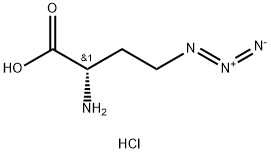
L-Azidohomoalanine (AHA) is a noncanonical amino acid analog of methionine that contains an azide moiety. AHA-labeling is a fast, sensitive, non-toxic, and non-radioactive alternative to the traditional technique for detecting nascent protein synthesis.
AHA is the cell-permeable compound randomly incorporated into synthesizing protein instead of methionine during translation. The resulting azide-labeled full-length proteins can be detected via copper-catalyzed click reaction (with fluorescent or biotin-labeled alkynes) or copper-free click reaction (with cycloalkynes) and used for subsequent microscopic imaging or purification tasks.
Uses
L-Azidohomoalanine (AHA) is an amino acid analog of methionine that contains a very small modification, specifically an azido moiety. This compound can be fed to cultured cells and incorporated into proteins during active protein synthesis. Detection utilizes the chemoselective ligation or “click ” reaction between an azide and an alkyne or cyclooctyne. For example the azido-modified protein can be detected with either fluorescent alkyne or biotin alkyne. Detection sensitivity with these reagents in 1-D gels and Western blots is in the low femtomole range and compatible with downstream LC-MS/MS and MALDI-MS analysis.