Uses
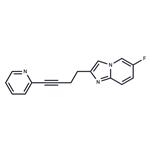
Dipraglurant (ADX48621) is a potent, selective, orally active and brain penetrant mGluR5 negative allosteric modulator (NAM), with an IC50 of 21 nM. Dipraglurant can reduce Levodopa-induced dyskinesia (LID) in vivo[1][2]. Dipraglurant is a click chemistry reagent, it contains an Alkyne group and can undergo copper-catalyzed azide-alkyne cycloaddition (CuAAc) with molecules containing Azide groups.
in vivo
Dipraglurant (3-30 mg/kg; a single p.o.) reduces L-dopa-induced chorea and dystonia and does not interfere with the efcacy of L-dopa in treating parkinsonian disability macaque[1].
Dipraglurant exhibits Cmax (1.040, 1.380, 5.310 ng/mL) Tmax (1.0, 0.5, 1.0 h) and AUCinf (2.230, 2.860, 15.700) following p.o. administration (3, 10, 30 mg/kg) in macaque[1].
References
[1] The Synthesis and Use of Certain Pyridine Derivatives as Modulators of the G-protein Coupled Receptors mGlu5 and P2Y12
[2] Bezard E, et, al. The mGluR5 negative allosteric modulator dipraglurant reduces dyskinesia in the MPTP macaque model. Mov Disord. 2014 Jul;29(8):1074-9. DOI:
10.1002/mds.25920[3] Sciamanna G, et, al. Negative allosteric modulation of mGlu5 receptor rescues striatal D2 dopamine receptor dysfunction in rodent models of DYT1 dystonia. Neuropharmacology. 2014 Oct;85:440-50. DOI:
10.1016/j.neuropharm.2014.06.013

![6-Fluoro-2-[4-(pyridin-2-yl)-3-butynyl]imidazo[1,2-a]pyridine Structure](https://www.chemicalbook.com/CAS/GIF/872363-17-2.gif)