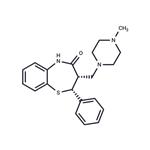
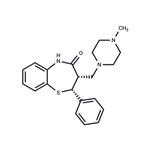
BTM-1086 prevents the development of ulcer at a dose of 0.1 to 1 mg/kg, p.o., but only weakly inhibits the histamine induced gastric ulcer. The inhibitory activities of BTM-1086 are significantly higher than those of atropine sulfate. In the healing experiment with the acetic acid-induced stomach ulcer, BTM-1086 (1 mg/kg/day , p.o., x14) shows a significant healing effect, which is higher than that of propantheline bromide . BTM-1086 at a dose of 0.2 mg/kg , i.d., remarkably inhibits the gastric secretion 6 hr after pylorus ligation. The aspirin-induced reductions of the total acid and K+ as well as the increments of the volume and Na+ in the gastric secretion are prevented dose-dependently by pretreatment with BTM-1086. The LD50 value by oral, s.c., and i.v. administration with this compound is 880, 630 and 113 mg/kg, respectively, for male rats and 830, 650 and 119 mg/kg, respectively, for female rats[2].

![1,5-Benzothiazepin-4(5H)-one, 2,3-dihydro-3-[(4-methyl-1-piperazinyl)methyl]-2-phenyl-, (2R,3S)-rel- Structure](https://www.chemicalbook.com/CAS/20200611/GIF/72293-17-5.gif)