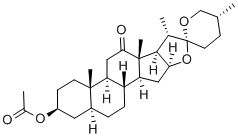
Description
Hecogenin acetate is a steroid sapogenin and an acetylated form of hecogenin that has anthelmintic and antinociceptive properties. It reduces the percentage of mobile larvae in goat fecal cultures containing
Haemonchus, Oesophagostomum, and
Trichostrongylus nematodes (EC
50 = 0.49 mg/ml). Hecogenin acetate (5, 10, or 20 mg/kg, i.p.) inhibits development of mechanical hyperalgesia induced by carrageenan, TNF-α, dopamine , and prostaglandin E
2 (PGE
2; ) in mice. It also increases latency to tail withdrawal in the tail flick test and has no effect on motor performance in the rotarod test in mice when administered at a dose of 40 mg/kg.
Uses
Hecogenin Acetate, is a derivative of Hecogenin (H129945), which is a sapogenin present in the leaves of species from the Agave genus, possessing wide spectrum of pharmacology activities, such as having antinociceptive properties.
Definition
ChEBI: HECOGENIN ACETATE is a triterpenoid.
Purification Methods
Crystallise the acetate from MeOH. [Beilstein 19 IV 2583.]
References
[1] ACIDáLIA CARINE VIEIRA SANTOS. In vitro ovicidal and larvicidal activities of some saponins and flavonoids against parasitic nematodes of goats.[J]. Parasitology, 2018, 145 14: 1884-1889. DOI:
10.1017/s0031182018000689[2] JULLYANA S S QUINTANS. Evidence for the involvement of spinal cord-inhibitory and cytokines-modulatory mechanisms in the anti-hyperalgesic effect of hecogenin acetate, a steroidal sapogenin-acetylated, in mice.[J]. Molecules, 2014, 19 6: 8303-8316. DOI:
10.3390/molecules19068303[3] KELLY BARBOSA GAMA. Evidence for the Involvement of Descending Pain-Inhibitory Mechanisms in the Antinociceptive Effect of Hecogenin Acetate[J]. Journal of Natural Products , 2013, 76 4: 559-563. DOI:
10.1021/np3007342