Chemical Properties
Colorless to yellow to orange liquid
Uses
Building block in the synthesis of an N
2S
2-N
4 porphyrin dyad used to study photoinduced energy transfer.
Uses
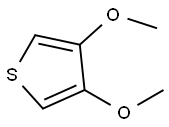
3,4-Dimethoxythiophene is used as an electronic materials intermediate. It is used as a starting material in the synthesis of porphyrin dyad which is used to study photoinduced energy transfer.
Synthesis Reference(s)
Journal of the American Chemical Society, 73, p. 2956, 1951
DOI: 10.1021/ja01150a525
General Description
3,4-Dimethoxythiophene (DMOT) is a monomer and a precursor which can be synthesized by ring closure reaction of 2,3-dimethoxy-1,3-butadiene and sulfur dichloride in hexane medium. It is an oligothiphene that is majorly used in the development of electroactive materials for organic electronics based applications.
Synthesis
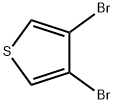
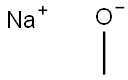
Under argon protection, 21 g of sodium methanolate and 72 g of methanol were added to a 100 mL four-necked flask (the initial concentration of sodium methanolate in methanol was 22.6 wt%) and stirred until complete dissolution. Subsequently, 0.83 g of cuprous bromide was added as a catalyst and 15 g of 3,4-dibromothiophene was slowly added dropwise, and the reaction solution gradually changed from colorless to black transparent. After the dropwise addition was completed, 50 g of methanol was removed by distillation (at this time the concentration of sodium methanolate in the remaining methanol rose to 48.8 wt%). The reaction mixture was heated to 97 °C for reflux reaction. The levels of 3,4-dibromothiophene and 3-bromo-4-methoxythiophene were monitored by gas chromatography and were below the detection limit after 5 h of reaction. After completion of the reaction, water was added to the mixture, filtered and the crude product was extracted with toluene. The toluene layer was sequentially washed with water and dried over magnesium sulfate. After filtration to remove the desiccant, the toluene layer was concentrated by rotary evaporation and finally vacuum distilled to give 7.28 g of 3,4-dimethoxythiophene in 81.5% yield. The product was analyzed by gas chromatography (Agilent 6890N network GC, FID detector) and the purity was 98.01%.
References
[1] Chinese Chemical Letters, 2014, vol. 25, # 4, p. 517 - 522
[2] Journal of Polymer Science, Part A: Polymer Chemistry, 2014, vol. 52, # 14, p. 1989 - 1999
[3] Patent: KR101558628, 2015, B1. Location in patent: Paragraph 0184-0190
[4] Tetrahedron, 1992, vol. 48, # 17, p. 3633 - 3652
[5] Langmuir, 2014, vol. 30, # 51, p. 15581 - 15589