Uses
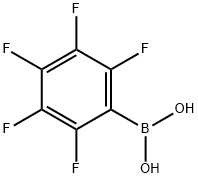
2,3,4,5,6-Pentafluorobenzeneboronic acid is utilized in the palladium-catalyzed Suzuki reaction to synthesize several cross-coupled aromatic compounds, for example bis(pentafluorophenyl)-substituted thiophene and selenophene derivatives. It serves as an intermediate and raw material in pharmaceutical and chemical industry. It is also used in dyes and pigments. It can be used to prepare cyclic boronates of bifunctional compounds.
Synthesis
Add 42 mmol (1.008 g) of magnesium flakes to a four-necked flask, add 2 pellets of iodine, then add about 5-10 mL of anhydrous 2-methyltetrahydrofuran, heat to 50 C, and then slowly allow the temperature to cool to 30 C. Add 10-15 drops of 2-methyltetrahydrofuran solution of pentafluorobenzene to the flask to initiate the Grignard reaction. Add 10~15 drops of 2-methyltetrahydrofuran solution of pentafluorobromobenzene to the flask to initiate the Grignard reaction, the temperature will rise rapidly after the initiation of the reaction, and then lower the temperature to 10 ~15 by using an ice bath, and then add the remaining pentafluorobromobenzene solution dropwise, the dropwise addition time was about 1.0~2.0 h, and the reaction was completed after the dropwise addition at room temperature for 12 h. The reaction was carried out at room temperature.
Weighing 48 mmol (4.992 g) of trimethyl borate, added to a four-necked flask, then added 2- methyl tetrahydrofuran dilution, the flask into a low temperature bath temperature down to -15 , and then slowly add the Gram reagent drops to the trimethyl borate, droplet time of 1.0 ~ 2.0 h, and then reacted for several hours at low temperature. At the end of the reaction, the reaction solution was slowly poured into dilute hydrochloric acid, stirred for 0.5~1.5 h after the dropwise addition, divided into liquids, and then extracted the aqueous phase for 2 times, combined with the organic phase, dried with anhydrous sodium sulfate, spun dry, and then recrystallized from ethylene dichloride to obtain white needle crystals of pentafluorophenylboronic acid with a yield of 70%. The HPLC purity was 95.6% and the melting point was 241.2~245.6 .