Synthesis
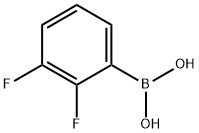
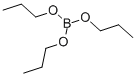
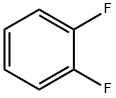
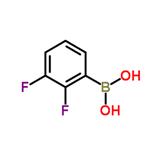
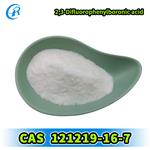
The general procedure for the synthesis of 2,3-difluorophenylboronic acid from tri-n-propyl borate and 1,2-difluorobenzene is as follows: in a 1L three-necked flask equipped with a mechanical stirrer, nitrogen inlet and outlet, pressure-balancing dropping funnel, and a thermometer, 1,2-difluorobenzene (40 g, 0.35 mol) and anhydrous tetrahydrofuran (400 ml) were added. Nitrogen was introduced to displace the air in the reaction system and a weak flow of nitrogen was maintained throughout the reaction. The reaction mixture was cooled to -78 °C using a dry ice/acetone bath, followed by the slow dropwise addition of 2.5 mol/L hexane solution of n-butyllithium (140 ml, 0.35 mol) through a dropping funnel, controlling the reaction temperature to not exceed -70 °C. After the dropwise addition of n-butyllithium solution was completed, the reaction mixture was continued to be stirred at -78 °C for 2 hours. Subsequently, tri-n-propyl borate (66 g, 0.35 mol) was added dropwise, again keeping the reaction temperature below -70 °C. After the addition of tri-n-propyl borate, the cooling bath was withdrawn and the reaction mixture was allowed to warm up naturally to room temperature with continuous stirring. Upon completion of the reaction, the solvent was removed by distillation under reduced pressure to give a viscous liquid residue. The residue was acidified and the resulting propanol was subsequently evaporated. The precipitated solid product was collected by filtration, washed with hexane and purified by aqueous recrystallization to give a final white crystalline 2,3-difluorophenylboronic acid 47 g in 85% of theoretical yield.
References
[1] Patent: US2013/20532, 2013, A1. Location in patent: Paragraph 0042
[2] Journal of Materials Chemistry C, 2014, vol. 2, # 5, p. 891 - 900