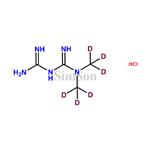
Description
Metformin-d
6 is intended for use as an internal standard for the quantification of metformin by GC- or LC-MS. Metformin is a biguanide with diverse biological activities. Metformin (250 mg/kg, i.p.) increases hepatic AMPK activity and reduces blood glucose by more than 50% in a liver kinase B1-dependent manner in mice fed normal and high-fat diets, respectively, and reduces blood glucose by 40% in
ob/ob mice. It reduces weight gain, hepatic lipid droplet content, and total cholesterol, LDL cholesterol, and triglyceride levels in the plasma of diet-induced obese mice when administered at doses of 10 or 50 mg/kg per day. It also reverses increased hepatic triglyceride and apolipoprotein A5 levels, as well as hepatic steatosis, in a dose-dependent manner in an
ob/ob mouse model of non-alcoholic fatty liver disease (NAFLD). Metformin (250 mg/kg) reduces tumor growth in an HCT116 p53
-\- human colon cancer mouse xenograft model, but has no effect on HCT116 p53
-\- tumors overexpressing recombinant
S. cerevisiae Ndi1 NADH dehydrogenase, a single-subunit ortholog of the multi-subunit mammalian mitochondrial complex I. Formulations containing metformin have been used in the treatment of type 2 diabetes.
References
[1] BENOIT VIOLLET. Cellular and molecular mechanisms of metformin: an overview.[J]. Clinical science, 2012, 122 6: 253-270. DOI:
10.1042/cs20110386[2] REUBEN J. SHAW. The Kinase LKB1 Mediates Glucose Homeostasis in Liver and Therapeutic Effects of Metformin[J]. Science, 2005, 310 5754. DOI:
10.1126/science.1120781[3] WILLIAM W WHEATON. Metformin inhibits mitochondrial complex I of cancer cells to reduce tumorigenesis.[J]. eLife, 2014: e02242. DOI:
10.7554/elife.02242[4] EUN KYUNG KIM. Metformin Prevents Fatty Liver and Improves Balance of White/Brown Adipose in an Obesity Mouse Model by Inducing FGF21[J]. Mediators of Inflammation, 2016, 42 1. DOI:
10.1155/2016/5813030[5] MIN-JIE LIN. Metformin improves nonalcoholic fatty liver disease in obese mice via down-regulation of apolipoprotein A5 as part of the AMPK/LXRα signaling pathway.[J]. Oncotarget, 2017, 8 65: 108802-108809. DOI:
10.18632/oncotarget.22163