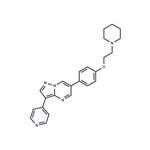
Description
Dorsomorphin (866405-64-3) is a potent, selective and ATP-competitive inhibitor of AMP-activated protein kinase (AMPK) (Ki = 109 nM).1 It displays no significant inhibition of ZAPK, SYK, PKCT, PKA and JAK3. It inhibits bone morphogenetic protein (BMP) type I receptors (ALK2, ALK3 and ALK6).2 Dorsomorphin has been shown to promote cardiomyogenesis in mouse embryonic stem cells (ESCs) in vitro.3 Dorsomorphin also induces autophagy in cancer cell lines via a mechanism independent of AMPK inhibition.4
Uses
A potent inhibitor of AMPK and fatty acid biosynthesis.
Uses
Dorsomorphin has been used:
- as an inhibitor of adenosine monophosphate-activated protein kinase (AMPK) to find the effects of trans-resveratrol on lipid mobilization in 3T3-L1 (a murine cell line of adipocytes) cells
- as an AMPK inhibitor, to indicate the involvement of AMPK/mTOR (mammalian target of rapamycin) pathway in LRG (liraglutide) -induced autophagy
- in the induction step, employed in in vitro differentiation of Friedreich′s ataxia (FRDA) and induced pluripotent stem cells (iPSCs) to neurospheres and neurons using ES (embryonic stem cell) media
Definition
ChEBI: A pyrazolopyrimidine that is pyrazolo[1,5-a]pyrimidine which is substituted at positions 3 and 6 by pyridin-4-yl and p-[2-(piperidin-1-yl)ethoxy]phenyl groups, respectively. It is a potent, selective, reversible, and ATP-competiti
e inhibitor of AMPK (AMP-activated protein kinase, EC 2.7.11.31) and a selective inhibitor of bone morphogenetic protein (BMP) signaling.
General Description
A cell-permeable pyrrazolopyrimidine compound that inhibits against KDR/VEGFR2, ALK2/BMPR-I, AMPK kinase activity (IC
50 = 25.1, 148, and 234.6 nM, respectively), while exhibiting much reduced or little effect toward ALK5/TGFβR-I, ZAPK, Syk, PKCθ, PKA, or JAK3. Shown to block both BMP pathway-dependent dorsoventral development (EC
100 = 2.5 μM) and VEGF signaling-dependent intersomitic vessel formation (EC
50 = 5 μM) in zebrafish embryo
in vivo. Commonly used in combination with AMPK activators AICAR (Cat. No.
123040) and/or Metformin (Cat. No.
317240) for studying AMPK-dependent cellular events
in vitro and physiological responses in animals
in vivo.
Biological Activity
Potent and selective inhibitor of AMP-activated protein kinase (AMPK) (K i = 109 nM). Displays no significant activity on several structurally related kinases including ZAPK, SYK, PKC θ , PKA and JAK3. Inhibits AMPK activation induced by AICAR and metformin. Also inhibits bone morphogenic protein (BMP) type I receptors (ALK2, ALK3 and ALK6). Promotes cardiomyogenesis in mouse embryonic stem cells (ESCs) in vitro .
Biochem/physiol Actions
Target IC50: 25.1, 148, and 234.6 nM, against KDR/VEGFR2, ALK2/BMPR-I, AMPK kinase activity, respectively
Background
Dorsomorphin is a potent and reversible AMP-activated protein kinase inhibitor that competes with ATP in the absence of AMP with a Ki value of 109 nM. This small compound is selective, displaying no significant inhibition of other kinases inclusive of ZAPK, SYK, PKCθ, PKA, and JAK3. Research has shown that Dorsomorphin inhibits tumor cell proliferation and induces apoptosis through mechanisms independent of the AMPK pathway. This compound inhibits the effects that AICAR and metformin have on inactivating acetyl-CoA carboxylase and selectively inhibits the BMP type I receptors ALK2, ALK3, and ALK6.
References
[1] ZHOU G, MYERS R W, LI Y, et al. Role of AMP-activated protein kinase in mechanism of metformin action.[J]. The Journal of clinical investigation, 2001, 1 1: 0. DOI:
10.1172/jci13505[2] PAUL B YU. Dorsomorphin inhibits BMP signals required for embryogenesis and iron metabolism[J]. Nature chemical biology, 2007, 4 1: 33-41. DOI:
10.1038/nchembio.2007.54[3] JIJUN HAO. Dorsomorphin, a selective small molecule inhibitor of BMP signaling, promotes cardiomyogenesis in embryonic stem cells.[J]. PLoS ONE, 2008, 3 8: e2904. DOI:
10.1371/journal.pone.0002904[4] LJUBICA VUCICEVIC. Compound C induces protective autophagy in cancer cells through AMPK inhibition-independent blockade of Akt/mTOR pathway.[J]. Autophagy, 2011, 7 1: 40-50. DOI:
10.4161/auto.7.1.13883

![6-[4-(2-PIPERIDIN-1-YLETHOXY)PHENYL]-3-PYRIDIN-4-YLPYRAZOLO[1,5-A]PYRIMIDINE Structure](https://www.chemicalbook.com/CAS/GIF/866405-64-3.gif)