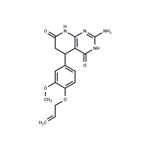
PA-8 is a potent, selective and orally active PACAP type I (PAC1) receptor antagonist. PA-8 inhibits the phosphorylation of CREB induced by PACAP in PAC1-, but not VPAC1- or VPAC2-receptor. PA-8 also inhibits PACAP-induced cAMP elevation with an IC50 of 2 nM[1][2].
PA-8 is a potent, selective, and orally active PACAP type I (PAC1) receptor antagonist. It inhibits PACAP-induced phosphorylation of CREB in PAC1 receptors, but not VPAC1 or VPAC2 receptors. It also inhibits PACAP-induced cAMP elevation with IC50 of 2 nM.
In PAC1/CHO cells, PA-8 (10 pM to 10 nM; 30 minutes) dose dependently inhibits PACAP (1 nM)-induced CREB phosphorylation. In VPAC1/CHO and VPAC2/CHO cells, PACAP ( 1 nM) also induced CREB phosphorylation; however, PA-8 (10 pM to 10 nM) does not inhibit PACAP (1 nM)-induced CREB phosphorylation.
PA-8 (100 pmol/5 μL; intrathecal injection; once; male ddY mice) treatment inhibits PACAP-induced aversive responses and mechanical allodynia in vivo.
[1] Ichiro Takasaki, et al. In Silico Screening Identified Novel Small-molecule Antagonists of PAC1 Receptor. J Pharmacol Exp Ther. 2018 Apr;365(1):1-8. DOI:
10.1124/jpet.117.245415[2] Ichiro Takasaki, et al. The novel small-molecule antagonist of PAC1 receptor attenuates formalin-induced inflammatory pain behaviors in mice. J Pharmacol Sci. 2019 Feb;139(2):129-132. DOI:
10.1016/j.jphs.2018.11.011

![2-amino-5-[3-methoxy-4-(prop-2-en-1-yloxy)phenyl]-3H,4H,5H,6H,7H,8H-pyrido[2,3-d]pyrimidine-4,7-dione Structure](/CAS/20200119/GIF/878437-15-1.gif)