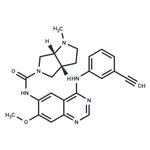
Theliatinib (Xiliertinib) is a potent, ATP-competitive, orally active and highly selective EGFR inhibitor with a Ki of 0.05 nM and an IC50 of 3 nM. Theliatinib has an IC50 of 22 nM for EGFR T790M/L858R mutant. Theliatinib shows >50-fold selectivity for EGFR than other kinases[1]. Theliatinib is a click chemistry reagent, it contains an Alkyne group and can undergo copper-catalyzed azide-alkyne cycloaddition (CuAAc) with molecules containing Azide groups.
Theliatinib (HMPL-309) is a potent EGFR inhibitor with a Ki value of 0.05 nM for EGFR and IC50 values of 3 nM and 22 nM for EGFR and EGFR T790M/L858R mutant, respectively. It is more than 50-fold selective for EGFR over 72 other kinases.
Compared with erlotinib or gefitnib, theliatinib has stronger binding affinity to wild-type EGFR and is more difficult to be replaced by ATP, which makes theliatinib have better target binding effect, and the EGFR-activated tumors have stronger antitumor activity.
Theliatinib has concentration-dependent antitumor activity in a series of patient-derived esophageal cancer xenograft models. But aberrant activation or genetic mutation of other targets such as PI3K and FGFR attenuates the antitumor activity of EGFR inhibitors, especially theliatinib.
| Target | Value |
WT EGFR
(Cell-free assay) | < td style="border-bottom: 1px dotted #ccc;padding: 5px;"> 3 nM
EGFR T790M/L858R
(Cell-free assay) | 22 nM |
EGFR: 3 nM (IC50); EGFR: 0.05 nM (Ki); EGFR (L858R/T790M): 22 nM (IC50)
[1] Ren Y, et al. Anti-tumor efficacy of theliatinib in esophageal cancer patient-derived xenografts models with epidermal growth factor receptor (EGFR) overexpression and gene amplification. Oncotarget. 2017 Apr 19;8(31):50832-50844. DOI:
10.18632/oncotarget.17243

![(3aR,6aR)-N-(4-((3-ethynylphenyl)amino)-7-methoxyquinazolin-6-yl)-1-methylhexahydropyrrolo[3,4-b]pyrrole-5(1H)-carboxamide Structure](/CAS/20180702/GIF/1353644-70-8.gif)