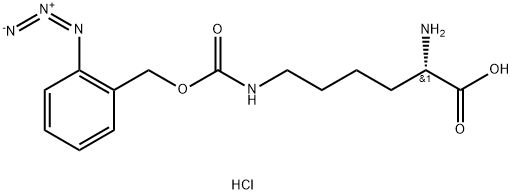
OABK is a small molecule switch that can be used to control protein activity. Genetic encoding of OABK using a pyrrolysyl tRNA synthetase/tRNACUA pair in mammalian cells enables the site-specific introduction of a small molecule-removable protecting group into the protein of interest. A phosphine-mediated Staudinger reduction is used to re-activate protein function.
OABK hydrochloride is a small-molecule switch that can be used to control protein activity. OABK (hydrochloride) is a click chemistry reagent, it contains an Azide group and can undergo copper-catalyzed azide-alkyne cycloaddition reaction (CuAAc) with molecules containing Alkyne groups. It can also undergo strain-promoted alkyne-azide cycloaddition (SPAAC) reactions with molecules containing DBCO or BCN groups.