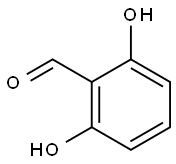
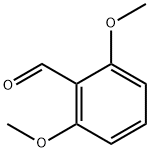
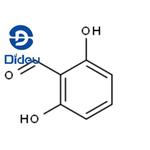
The general procedure for the synthesis of 2,6-dihydroxybenzaldehyde from 2,6-dimethoxybenzaldehyde was as follows: a dichloromethane (1200 mL) solution of AlCl3 (240 g, 1.80 mol, 3.00 eq.) was added to a 3000 mL three-necked round bottom flask. The reaction mixture was cooled to 0 °C, followed by the slow dropwise addition of a dichloromethane (800 mL) solution of 2,6-dimethoxybenzaldehyde (100 g, 601.78 mmol, 1.00 equiv). After the dropwise addition was completed, the reaction mixture was stirred at room temperature overnight. Upon completion of the reaction, the reaction was quenched with 200 mL of dilute hydrochloric acid (2 M). The reaction mixture was extracted with dichloromethane (2 x 200 mL). The organic layers were combined and concentrated under vacuum. The concentrated residue was purified by silica gel column chromatography using ethyl acetate/petroleum ether (1:200 to 1:50) as eluent to give 40 g (48% yield) of 2,6-dihydroxybenzaldehyde as a yellow solid. The product was characterized by 1H NMR (300 MHz, DMSO-d6): δ 11.25 (s, 2H), 10.25 (s, 1H), 7.36 (m, 1H), 6.36 (d, J = 8.4 Hz, 2H); mass spectrum (ESI) m/z 139 [M + H]+.