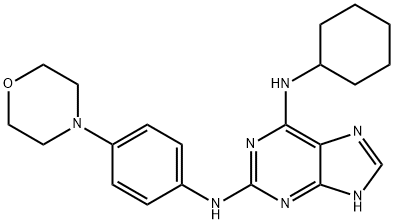
Reversine is a 2,6-disubstituted purine derivative that was originally found to induce dedifferentiation of C2C12 culture myoblast cells into stem cell progenitors when used at a concentration of 5 μM for four days. Depending on cell type, reversine promotes either differentiation or dedifferentiation. For example, in NT2 neuronal and HL-60 human promyelocytic leukemia cells, it induces differentiation. It inhibits the Aurora A, B, and C kinases with IC50 values of 98-876 nM and acts as an antagonist at the adenosine A3 receptor with a Ki value of 0.66 μM. Reversine is also used for studies of chromosome segregation. It inhibits the mitotic spindle checkpoint enzyme MPS1 with IC50 values of 6 and 2.8 nM for its kinase domain and full-length version, respectively). Reversine induces autophagy in WRO human follicular thyroid cancer cells and decreases Akt/mTOR signaling.
Reversine acts as a potent human A3 adenosine receptor antagonist and pan-aurora A/B/C kinase inhibitor. Used for stem cell differentiation.
ChEBI: A member of the class of purines that is 9H-purine in which the hydrogens at positions 2 and 6 are replaced by a [4-(morpholin-4-yl)phenyl]nitrilo group and a cyclohexylamino group, respectively.
Reversine was first described as a synthetic substituted purine with activity as a dedifferentiation agent; it was shown to induces differentiated lineage-committed cells to become multipotent mesenchymal stem cells (MSCs). Reversine has also been show to have activity as a potent, selective human A3 adenosine receptor antagonist (Ki value of 0.66 μM), as an ATP-competitive Aurora kinase inhibitor, and as a Mps1 kinase inhibitor. Additionally, studies have shown reversine to be an anti-cancer agent, inhibiting growth and inducing cell death in various cancer cell types.
reversine could be used to induce dedifferentiation of murine myoblasts. previous reports also showed that reversine had a role in regeneration. moreover, a recent report indicated reversine had anti-tumor capabilities for a myeloma cell line, as demonstrated by that reversine could suppress the expression of cell cycle related proteins aurora kinase a and aurora kinase b [1].
the effects of reversine on tumor weight and volume were assessed using a murine model of cervical cancer with u14 cells, separately or combined with aspirin. the inhibition rate of cells in the combination group significantly increased; moreover, such combination could synergistically inhibit the proliferation of five cervical cancer cell lines. in the mouse model, tumor weight and volume of cervical cancer bearing mice were more reduced [1].
150, 500 and 400 nm for aurora kinase a, b and c respectively
[1] SHUIBING CHEN. Dedifferentiation of Lineage-Committed Cells by a Small Molecule[J]. Journal of the American Chemical Society, 2003, 126 2: 410-411. DOI:
10.1021/ja037390k[2] SHUIBING CHEN. Reversine increases the plasticity of lineage-committed mammalian cells.[J]. Proceedings of the National Academy of Sciences of the United States of America, 2007, 104 25: 10482-10487. DOI:
10.1073/pnas.0704360104[3] MELISSA PERREIRA. “Reversine” and Its 2-Substituted Adenine Derivatives as Potent and Selective A3 Adenosine Receptor Antagonists[J]. Journal of Medicinal Chemistry, 2005, 48 15: 4910-4918. DOI:
10.1021/jm050221l