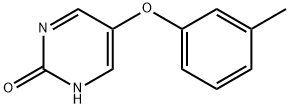
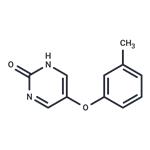
MLR-1023 is an allosteric activator of Lyn kinase (EC50 = 63 nM). It has no significant activity against a panel of related kinases. MLR-1023 is orally bioavailable and reduces blood glucose levels in mice subjected to an oral glucose tolerance test. This effect is insulin-dependent, with MLR-1023 increasing insulin receptor sensitivity. MLR-1023 produces a dose-dependent and durable glucose-lowering effect in chronically treated db/db mice without causing weight gain.
Tolimidone (MLR-1023) is an allosteric Lyn kinase activator that has been shown to reduce blood glucose levels in mice. Studies show that Tolimidone is an effective insulin receptor-potentiating agent that is potentially capable of producing durable blood glucose-lowering activity in diabetics. Tolimidone is a candidate for the treatment of type 2 diabetes.
Fill a 3-liter 3-neck flask equipped with a pressure dropping funnel. Add 99.1 g (1.5 mol) of 85% KOH pellets to an O-head stirrer and a condenser with solvent lead-in. The dry flask was heated and 170.0 g (1.5 mol) of m-cresol was added to the stirred hot KOH pellet. The flask was kept at a temperature of 90-100C for the contents so that the phenol salt anion did not precipitate. A clarified solution of molten potassium-isophthalate and water was obtained. To the stirred molten solution was added 375 g of chloroacetaldehyde diethyl acetal (boiling point 152-6) at a rate such that the mixture was maintained at 90-100C. The mixture (both phases) is stirred rapidly and heated to remove the azeotrope of acetal and water by removal from the condenser. Distillation was continued until the distillate vapor reached 140-150C. On cooling, the azeotrope separates into a water layer and an acetal layer and the acetal can be added back into the reaction mixture. The mixture is stirred vigorously and heated for 6 hours (or overnight), during which time the solid potassium chloride is separated. The crude cooled mixture is poured into a stirred solution of ice water and ether. The layers were separated and the aqueous layer was washed with two additional portions of ether. The combined ether solutions were washed with a cold 2N NaOH solution, then dried over anhydrous sodium sulfate, treated with activated charcoal, and concentrated on a steam bath to give a mobile amber-colored oil weighing 424g. The residual trace ether was removed by distillation at atmospheric pressure, and then the excess chloroacetaldehyde diethyl acetal was removed by distillation at absorber pressure (20 mm). Final distillation under high vacuum at 0.2-0.3 mmHg, 90-95 C gave 291.7 g of m-methylphenoxyacetaldehyde diethyl acetal as a clear colorless oil.
[1] MICHAEL S SAPORITO. MLR-1023 is a potent and selective allosteric activator of Lyn kinase in vitro that improves glucose tolerance in vivo.[J]. ACS Applied Electronic Materials, 2012: 15-22. DOI:
10.1124/jpet.112.192096[2] ALEXANDER R OCHMAN. The Lyn kinase activator MLR-1023 is a novel insulin receptor potentiator that elicits a rapid-onset and durable improvement in glucose homeostasis in animal models of type 2 diabetes.[J]. Journal of Pharmacology and Experimental Therapeutics, 2012, 342 1: 23-32. DOI:
10.1124/jpet.112.192187