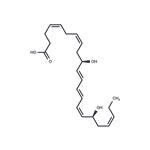
Protectin D1 is a specialized pro-resolving mediator (SPM) synthesized from docosahexaenoic acid (DHA; ). DHA is oxidized to 16S,17S-epoxy-protectin, which is converted to protectin D1 enzymatically. Protectin D1 increases phagocytosis of apoptotic polymorphonuclear leukocytes (PMNs) by macrophages in a non-phlogistic manner and is generated in vitro during macrophage-apoptotic interactions. It enhances phagocytosis in mice after 24 hours, but not at the initiation or peak of inflammation. It also decreases PMN infiltration in a zymosan-induced mouse model of inflammation when administered at a dose of 300 ng per animal. Protectin D1 (200 μg, i.v.) inhibits increases in neutrophil counts in bronchoalveolar fluid (BALF) and lung myeloperoxidase activity in a mouse model of pulmonary injury and inflammation induced by intratracheal LPS instillation. It also decreases pulmonary edema and promotes neutrophil apoptosis in BALF.
ChEBI: Protectin D1 is a dihydroxydocosahexaenoic acid that is (4Z,7Z,11E,13E,15Z,19Z)-docosahexaenoic acid in which the two hydroxy substituents are located at positions 10 and 17 (the 10R,17S-stereoisomer). Protectin D1 is one of the specialised proresolving mediators. When produced in neural tissues, it is called neuroprotectin D1 It has a role as an anti-inflammatory agent, a neuroprotective agent, a PPARgamma agonist, an apoptosis inhibitor, a hepatoprotective agent, a human xenobiotic metabolite and a specialised pro-resolving mediator. It is a dihydroxydocosahexaenoic acid, a secondary allylic alcohol and a protectin.
[1] ANA R. RODRIGUEZ Bernd W S. Total synthesis of pro-resolving and tissue-regenerative Protectin sulfido-conjugates[J]. Tetrahedron Letters, 2015, 56 42: Pages 5811-5815. DOI:
10.1016/j.tetlet.2015.09.020[2] JAN M. SCHWAB. Resolvin E1 and protectin D1 activate inflammation-resolution programmes[J]. Nature, 2007, 447 7146: 869-874. DOI:
10.1038/nature05877[3] XINGWANG LI. Protectin D1 promotes resolution of inflammation in a murine model of lipopolysaccharide-induced acute lung injury via enhancing neutrophil apoptosis.[J]. Chinese Medical Journal, 2014, 127 5: 810-814.