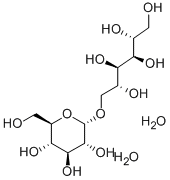
ChEBI: Isomalt is a diastereoisomeric mixture composed of 1-O-alpha-D-glucopyranosyl-D-mannitol dihydrate and 6-O-alpha-D-glucopyranosyl-D-glucitol in a 1:1 ratio. It is used in the food industry as a sugar substitute and in the pharmaceutical industry as a tabletting excipient. It has a role as a sweetening agent, an excipient and a plasticiser. It contains a 6-O-alpha-D-glucopyranosyl-D-glucitol and a 1-O-alpha-D-glucopyranosyl-D-mannitol dihydrate.
The synthesis of 1-O--D-glucopyranosyl-D-mannitol dihydrate (hereinafter referred to as 1,1-GPM) is generally a two-step process: 1) the enzymatic conversion of sucrose to isomaltosucrose in the first place, and 2) the subsequent hydrogenation of the isolated isomaltosucrose over a Raney nickel catalyst. Where the conversion of sucrose to isomaltosucrose can be accomplished by the microorganism Prochlorococcus erythropolis, the isomaltosucrose obtained in this manner is converted by hydrogenation in the presence of a Raney nickel catalyst to a mixture of 1,1-GPM and 6-O--D-glucopyranosyl-D-sorbitanol (abbreviated to 1,6-GPS), which is then concentrated by a process of evaporation and cooling crystallization.