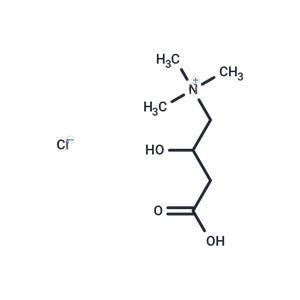
| Name | (±)-Carnitine chloride |
| Description | (±)-Carnitine chloride (Monocamin) is a quaternary ammonium compound biosynthesized from the amino acids lysine and methionine. |
| Kinase Assay | Mitochondria (0.6 mg protein/mL) are incubated in 2.5 mM Hepes (pH7.4) containing 225 mM mannitol, 75 mM sucrose and 100 μM ethylene glycol tetraacetic acid (EGTA) with or without 5 mM L-carnitine at 25°C. To measure oxygen uptake, 10 min after inorganic phosphate (Pi) 4 mM are added, the mitochondria are treated with palmitoyl-CoA (50 μM) and then ADP is added (200 μM). Oligomycin (5 μM) and rotenone (10 μM) are added 3-4 min after the ADP treatment. HPG (0-10 mM), which can specifically inhibit carnitine palmitoyl transferase (CPT)-I activity in the mitochondria, is added in the Hepes medium before incubation of the mitochondria[1]. |
| In vitro | L-carnitine primarily facilitates the translocation of long-chain fatty acids across the inner mitochondrial membrane by transforming acyl-CoA into acyl-carnitine via carnitine palmitoyl transferase (CPT)-I activation. This acyl-carnitine is then converted back into acyl-CoA within the mitochondrial matrix by CPT-II. L-carnitine's introduction enhances palmitoyl-CoA-induced mitochondrial respiration, further accelerated by ADP, showcasing a concentration-dependent effect that reaches saturation at 5 mM L-carnitine[1]. Additionally, L-carnitine pre-treatment enhances Nrf2 nuclear translocation, its DNA binding activity, and heme oxygenase-1 (HO-1) expression in Water2-treated HL7702 cells, providing protection against Water2-induced cell damage through Akt-mediated Nrf2 signaling pathway activation[2]. |
| In vivo | L-carnitine has been shown to modulate the ubiquitin-proteasome pathway and enhance IGF-1 levels in animal studies. Its administration over two weeks can mitigate muscle mass and fiber size reduction in the soleus muscle caused by hindlimb suspension. Additionally, L-carnitine inhibits atrogin-1 mRNA expression, crucial for preventing muscle atrophy. Concurrent L-carnitine treatment also reduces renal fibrosis—associated with lowered plasma TGF-β1 levels—and addresses the enhanced oxidative and inflammatory states observed in L-NAME treated groups, alongside promoting PPAR-γ expression. |
| Storage | Powder: -20°C for 3 years | In solvent: -80°C for 1 year | Shipping with blue ice/Shipping at ambient temperature. |
| Solubility Information | H2O : 37 mg/mL (187.19 mM), Sonication is recommended.
Ethanol : < 1 mg/mL (insoluble or slightly soluble)
DMSO : 45 mg/mL (227.66 mM), Sonication is recommended.
10% DMSO+40% PEG300+5% Tween 80+45% Saline : 2 mg/mL (10.12 mM), Sonication is recommended.
|
| Keywords | ReactiveOxygenSpecies | Reactive Oxygen Species | Inhibitor | inhibit | DL-Carnitine Chloride | DL-Carnitine | Carnitine Chloride | (±)Carnitine chloride | (±)-Carnitine | (±) Carnitine chloride |
| Inhibitors Related | Ethoxyquin | Kaolin | Allopurinol | Cysteamine hydrochloride | L-Ascorbic acid | Ethyl linoleate | Inosine | L-Cystine | Copper Sulfate Pentahydrate | L-Ascorbic acid sodium salt | Sodium 2-oxopropanoate | Dimethyl phthalate |
| Related Compound Libraries | Bioactive Compound Library | Drug Repurposing Compound Library | Natural Product Library | Anti-Prostate Cancer Compound Library | Natural Product Library for HTS | Anti-Cancer Approved Drug Library | FDA-Approved Drug Library | Immunology/Inflammation Compound Library | Anti-Aging Compound Library | Bioactive Compounds Library Max | Anti-Cancer Drug Library | Oxidation-Reduction Compound Library |


 United States