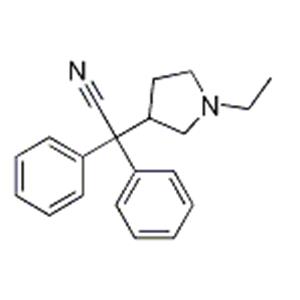
Product name: 2-(1-ethylpyrrolidin-3-yl)-2,2-diphenylacetonitrile
CAS Number:3212-87-1
Molecular Weight: 290.4
Molecular Formula:C20H22N2
Hazard Overview:
Emergency Overview: No data
GHS hazard category: no data
Label Elements:
Pictogram: No data
Warning: No data
Hazard Statement: No information
Precautionary Notes:
Precautionary measures: No data available
Incident Response: No data available
Secure Storage: No data
Disposal: No data
Physical and chemical hazards: No data available
Health hazards: No data available
Environmental hazards: No data available
First Aid Measures:
Emergency:
Inhalation: If inhaled, move the patient to fresh air.
Skin-to-skin contact: Remove contaminated clothing and rinse skin thoroughly with soap and water. If you feel unwell, seek medical attention.
Ocular contact: Separate eyelids and rinse with running water or saline. Seek immediate medical attention.
Ingestion: Rinse your mouth, prohibit vomiting. Seek immediate medical attention.
Advice for protecting rescuers: Move the patient to a safe place. Consult a doctor. Present this SDS to the doctor who is present at the scene.
Special note for doctors: No data
Fire protection measures:
Fire extinguishing agent: extinguishing the fire with water mist, dry powder, foam or carbon dioxide extinguishing agent. Avoid using direct flow water to extinguish fires, which may cause splashing of flammable liquids and spread the fire.
Special Risk: No data available
Fire extinguishing precautions and protective measures:
Firefighters are required to wear air-carrying breathing apparatus and full-body firefighting suits to extinguish fires in the upwind direction.
Move containers from the fire to an open area as much as possible.
Containers in the middle of a fire must be evacuated immediately if they have changed color or emitted a sound from the safety pressure relief device.
Isolate the scene of the accident and prohibit unrelated personnel from entering.
Containment and treatment of fire water to prevent environmental pollution.
Emergency Handling of Leakage:
Protective measures, protective equipment and emergency response procedures for workers:
Emergency responders are advised to wear air-carrying respirators, anti-static clothing, and rubber oil-resistant gloves.
Do not touch or cross the spill.
All equipment used for the job should be grounded.
Cut off the source of the leak as much as possible. Eliminate all ignition sources.
The warning area is demarcated according to the influence area of liquid flow, steam or dust diffusion, and unrelated personnel are evacuated to the safety zone from the crosswind and upwind direction.
Environmental protection measures: Contain spills to avoid polluting the environment. Prevent spills from entering sewers, surface water, and groundwater.
How to contain, clean, and dispose of spilled chemicals: Small leaks: Collect spilled liquids in airtight containers whenever possible. Absorb with sand, activated carbon or other inert materials and move to a safe place. It is forbidden to flush down the drain.
Massive leakage: Construct embankments or dig pits to contain them. Close the drain pipes. Cover with foam to inhibit evaporation. The explosion-proof pump is transferred to a tanker or a special collector for recycling or transported to a waste disposal site for disposal.
Handling, Handling & Storage:
Precautions:
Operators should be specially trained and strictly follow the operating procedures.
The operation and disposal should be carried out in a place with local ventilation or full ventilation facilities.
Avoid contact between eyes and skin and avoid inhaling steam.
Keep away from fire and heat sources, and smoking is strictly prohibited in the workplace.
Use explosion-proof ventilation systems and equipment.
If canning is required, the flow rate should be controlled and there should be a grounding device to prevent static electricity from accumulating.
Avoid contact with prohibited substances such as oxidants.
When handling, it is necessary to load and unload lightly to prevent damage to the packaging and containers.
Empty containers may leave harmful substances behind.
Wash your hands after use and refrain from eating or drinking in the workplace.
Equipped with corresponding varieties and quantities of fire-fighting equipment and leakage emergency treatment equipment.
Precautions for storage:
Store in a cool, ventilated warehouse.
The storage temperature should not exceed 37°C.
It should be stored separately from oxidants and edible chemicals, and should not be mixed.
Keep the container tightly sealed.
Keep away from fire and heat sources.
The warehouse must be equipped with lightning protection equipment.
The exhaust system should be equipped with a grounding device to dissipate static electricity.
Explosion-proof lighting and ventilation are adopted.
It is forbidden to use equipment and tools that are prone to sparks.
The storage area should be equipped with emergency response equipment for spills and suitable containment materials.


 China
China