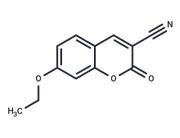
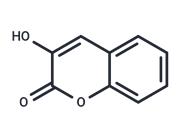
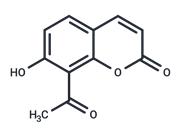
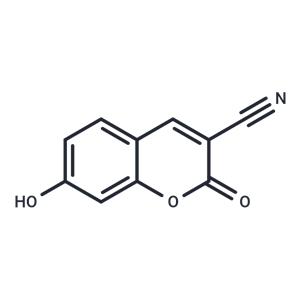
| Name | 3-Cyano-7-hydroxycoumarin |
| Description | 3-Cyano-7-hydroxycoumarin (3-Cyanoumbelliferone) is a macrophage inhibitor of macrophage inhibitory factor (MIF) interconjugate isomerase with a Ki of 2.9 μM. 3-Cyano-7-hydroxycoumarin belongs to the group of coumarin derivatives, which can be used as molecular probes and fluorescent dyes. |
| In vitro | Instructions
I. Solution preparation
1. Preparation of mother solution and working solution: It can be dissolved in DMSO and further diluted to aqueous buffer solution as working solution in the experiment.
II. Operation steps
1. Sample preparation
Target molecule: This probe is mainly used to detect MIF activity, or as a general fluorescent dye. It can be used to study the role of MIF in inflammation, cancer and immune response.
Concentration: For fluorescence experiments, a solution with a concentration of 1–10 μM is usually used, and the specific concentration is adjusted according to the sensitivity and requirements of the experiment.
2. Experimental conditions
1) Buffer selection: In order to study MIF inhibition, it is recommended to select a suitable buffer (such as phosphate buffer with a pH range of 7.0–7.5) to simulate physiological conditions.
2) Add 3-Cyano-7-hydroxycoumarin: Add an appropriate amount of 3-Cyano-7-hydroxycoumarin solution (usually 0.1–1 mM) to the sample.
3) Reaction temperature and time: Typically, the reaction temperature is room temperature to 37°C. The reaction time depends on the activity of the enzyme in the sample and is usually between 30 minutes and 1 hour.
4) Hydrogen peroxide (H₂O₂) is usually added as an oxidant to initiate the reaction.
5) Color change: After the reaction is completed, the product is usually brown or dark in color and can be quantitatively detected using colorimetric methods (such as UV-Vis spectrophotometer).
3. Fluorescence imaging
3-Cyano-7-hydroxycoumarin can be used as a fluorescent probe to track molecular interactions or the activity of biomolecules such as MIF in live cell imaging.
Detection: Fluorescence intensity is quantified by fluorescence microplate reader, confocal microscopy or flow cytometry.
4. Inhibition assay
For MIF tautomerase inhibition assay, 3-Cyano-7-hydroxycoumarin can be used to determine its inhibitory potency with a Ki value of 2.9 μM.
Methods: The inhibition of MIF by 3-Cyano-7-hydroxycoumarin was evaluated by measuring the fluorescence quenching effect.
Storage conditions
1) 3-Cyano-7-hydroxycoumarin should be stored in a dry, cool place at -20°C, away from light and moisture.
2) The solution should be freshly prepared and, if storage is required, should be stored at -20°C or below and away from light.
The above information is based on published literature. Experimental procedures should be appropriately modified to meet specific research demands. |
| Storage | Shipping with blue ice/Shipping at ambient temperature. |
| Solubility Information | DMSO : 15 mg/mL (80.15 mM), Sonication is recommended.
|
| Keywords | MIF | 3-Cyano-7-hydroxycoumarin |
| Inhibitors Related | RDR03785 | MIF-IN-2 | Carebastine | 4-CPPC | 4-IPP | Mitomycin A | BTZO-1 | MIF098 | Iguratimod | Imalumab | (±)-CPSI-1306 | ISO-1 |
| Related Compound Libraries | Bioactive Compound Library | Inhibitor Library | Immunology/Inflammation Compound Library | Bioactive Compounds Library Max |


 United States