4-Bromophenylacetic acid is an organic compound with the chemical formula C₈H₇BrO₂. Its structure consists of:
Phenyl ring: A benzene ring.
4-Bromo substituent: A bromine atom attached to the para position (opposite side) of the ring.
Acetic acid group: A -CH₂COOH group attached directly to the benzene ring.
Key Characteristics:
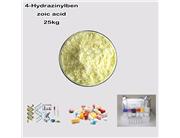
Appearance: Typically a white to off-white crystalline solid.
Molecular Weight: 215.05 g/mol.
CAS Number: 1878-68-8.
Melting Point: ~115-118 °C.
Acidity: Behaves as a typical carboxylic acid (can form salts, esters, amides).
Primary Uses (Building Block):
It serves as a versatile synthetic intermediate in organic chemistry, particularly for:
Pharmaceuticals: Synthesis of drug candidates (e.g., some anti-inflammatory agents).
Agrochemicals: Production of pesticides or herbicides.
Liquid Crystals & Materials Science: Building block for more complex molecules.
Coupling Reactions: The bromine atom readily participates in reactions like Suzuki-Miyaura coupling to form new carbon-carbon bonds, attaching other aryl/heteroaryl groups.
Derivatization: The carboxylic acid group can be easily modified (e.g., to esters, amides, or reduced).
Safety: It is generally classified as corrosive and an irritant (skin, eyes, respiratory system). Proper handling (gloves, goggles, fume hood) is essential.
In short: It's a brominated aromatic carboxylic acid used mainly as a starting material or intermediate for synthesizing more complex molecules in research and industry.