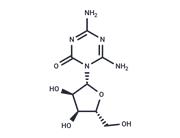
| Name | 5-Azacytidine |
| Description | 5-Azacytidine (Ladakamycin) is a cytidine nucleoside analog, a DNA methylation inhibitor with specificity. 5-Azacytidine regulates gene expression by decreasing the level of DNA methylation. 5-Azacytidine induces autophagy and has antitumor activity. |
| Cell Research | 5 mL of L1210 cells (5 × 10³ cells/mL) are incubated with Azacitidine at 37 ℃ for 3 days. Cell number is determined twice a day for 3 days by means of a Model A Coulter counter.(Only for Reference) |
| Kinase Assay | A crude cell-free extract is isolated from LI 210 cells in culture by suspension of the cells in a given volume of 0.05mol/LTris-HCl buffer, pH 7.4, and sonic extraction with a Biosonik at 70% maximal output for 30 sec. The supernatant is collected after centrifugation at 105,000 × g for 60 min (4°C) in a Model L Spinco ultracentrifuge. The final protein concentration of the cell-free extracts is approximately 3 mg/mL. The extracts are used as the source of enzymes. Ribonucleotide reductase activity is measured. A unit of enzyme is defined as the amount that catalyzed dCMP synthesis at a rate of 1 mμmole/hr. The assay systems for the measurement of pyrimidine nucleoside (CR) and deoxynucleoside (TdR, CdR) kinases are essentially those described by Chu and Fischer. However, reactions are terminated by heating for 2 min in a boiling water bath, and the phosphorylated derivatives are isolated according to the method of Bach. Fifty-jul aliquots are applied to 1-inch discs of diethylaminoethyl paper, which are then placed in counting vials and eluted with 0.5 mL of 0.5 mol/LPCA. After 1 hr, 12 mL of Diotol are added, and the radioactivity is determined. |
| In vitro | In leukemic BDF1 mice bearing L1210 ascitic tumor cells, intraperitoneal administration of Azacitidine (3 mg/kg) inhibits polynucleotide synthesis and prolongs survival time. |
| In vivo | In both regular eukaryotic cells and cancer cells, Azacitidine activates nucleoside triphosphates and inhibits the synthesis of DNA, RNA, and proteins, ultimately leading to cell death. Azacitidine induces cell differentiation and myotube formation in C3H10T1/2 cells. Additionally, Azacitidine suppresses cell growth in L1210 cells (IC50=0.019 μg/mL). |
| Storage | Powder: -20°C for 3 years | In solvent: -80°C for 1 year
Shipping with blue ice/Shipping at ambient temperature. |
| Solubility Information | DMSO : 262.5 mg/mL (1074.94 mM), Sonication is recommended.
PBS : 10 mg/mL (40.95 mM), Sonication and heating are recommended.
H2O : 10 mg/mL (40.95 mM), Sonication and heating are recommended.
5% DMSO+40% PEG300+5% Tween 80+50% Saline : 1 mg/mL (4.1 mM), Solution.
|
| Keywords | NucleosideAntimetabolite | Nucleoside Antimetabolite/Analog | Nucleoside Antimetabolite | NSC-102816 | NSC102816 | DNMTs | DNAMethyltransferase | DNA MTases | DNA methyltransferase (DNMT) | DNA Methyltransferase | Bacterial | Autophagy | Antibiotic | Analog | 5-Azacytidine | 5Azacytidine | 5 Azacytidine |
| Inhibitors Related | Neomycin sulfate | Aceglutamide | Hemin | D(+)-Raffinose pentahydrate | Guanidine hydrochloride | Sulfamethoxazole sodium | Terbinafine hydrochloride | Hydroxychloroquine | Hyaluronic acid sodium (MW 20 kDa) | Dimethyl sulfoxide | Sodium diacetate | Sodium bicarbonate |
| Related Compound Libraries | Anti-Tumor Natural Product Library | Anti-Cancer Clinical Compound Library | Drug Repurposing Compound Library | Anti-Viral Compound Library | Inhibitor Library | Microbial Natural Product Library | Natural Product Library for HTS | FDA-Approved Drug Library | Anti-Cancer Approved Drug Library | Anti-Aging Compound Library | Anti-infective Natural Product Library | Anti-Cancer Drug Library |



 United States