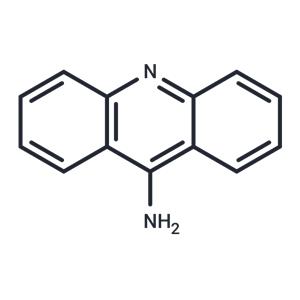
| Name | 9-Aminoacridine |
| Description | 9-Aminoacridine is a highly fluorescent anti-infective dye used clinically as a topical antiseptic and experimentally as a mutagen, due to its interaction with DNA. It is also used as an intracellular pH indicator. |
| Cell Research | I. Solution preparation
1. Preparation of stock solution: Dissolve it in DMSO (dimethylsulfonamide) or water to prepare the stock solution, usually at a concentration of 1-10mM. It can be adjusted according to actual conditions.
2. Preparation of working solution: Dilute it to an appropriate concentration with PBS/DMEM/H2O before use. The common working concentration is 1-10 μM, but the specific concentration should be optimized according to experimental requirements.
II. Cell labeling
1) Cell culture: Inoculate cells into appropriate culture dishes and culture to an appropriate density (e.g. 24 hours, the number of cells is 70%-80% density).
2) Labeling cells: Add a working concentration of 9-Aminoacridine solution to the cell culture medium. The general incubation time is 30 minutes to 1 hour, which can be adjusted according to experimental requirements.
3) Washing cells: After labeling, wash the cells thoroughly with PBS (phosphate buffered saline) to remove unbound 9-Aminoacridine.
4) Fluorescence detection:
Excitation and emission wavelengths: 9-Aminoacridine is excited at ex = 365 nm and emits fluorescence at em = 460 nm, producing bright blue fluorescence.
Fluorescence microscopy or flow cytometry: Use a suitable fluorescence microscope or flow cytometer for fluorescence detection to observe the fluorescence intensity in the cells.
Precautions:
1. Protect from light: 9-Aminoacridine is sensitive to light, especially when exposed to strong light, the fluorescence intensity will change. Avoid exposure to strong light when using it.
2. Solubility: It has different solubility in different solvents, and the solubility needs to be confirmed before use.
3. Cytotoxicity: Higher concentrations of 9-Aminoacridine may be toxic to cells, so the concentration should be optimized to avoid excessive cell toxicity.
The above information is based on published literature. Experimental procedures should be appropriately modified to meet specific research demands. |
| Storage | keep away from direct sunlight | Powder: -20°C for 3 years | In solvent: -80°C for 1 year | Shipping with blue ice/Shipping at ambient temperature. |
| Solubility Information | DMSO : 50 mg/mL (257.43 mM), Sonication is recommended.
10% DMSO+40% PEG300+5% Tween-80+45% Saline : 2.5 mg/mL (12.87 mM), Sonication is recommended.
|
| Keywords | Inhibitor | inhibit | Human immunodeficiency virus | HIVProtease | HIV Protease | HIV | Bacterial | 9-Aminoacridine | 9Aminoacridine | 9 Aminoacridine |
| Inhibitors Related | Neomycin sulfate | Emtricitabine | Adipic dihydrazide | Levulinic acid | D(+)-Raffinose pentahydrate | Sulfamethoxazole sodium | Terbinafine hydrochloride | Lamivudine | Doxycycline | Hyaluronic acid sodium (MW 20 kDa) | Dimethyl sulfoxide | Sodium diacetate |
| Related Compound Libraries | FDA-Approved & Pharmacopeia Drug Library | Bioactive Compound Library | ReFRAME Related Library | Drug Repurposing Compound Library | Anti-Viral Compound Library | Anti-Bacterial Compound Library | Bioactive Compounds Library Max | Anti-Infection Compound Library | Human Metabolite Library |


 United States