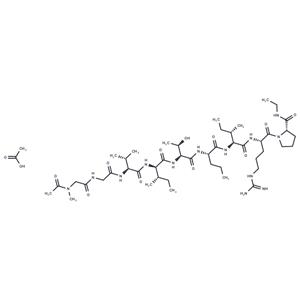
| Name | ABT-510 acetate |
| Description | ABT-510 acetate is an endogenous anti-angiogenic TSP peptide inhibitor, a thrombospondin analog, with anti-inflammatory, anti-cancer and anti-angiogenic activity that induces apoptosis and inhibits ovarian tumor growth in an orthotopic, syngeneic model of epithelial ovarian cancer.ABT-510 acetate reduces angiogenesis and inflammatory responses in a mouse model of inflammatory bowel disease. ABT-510 acetate reduces angiogenesis and inflammation in mouse models of inflammatory bowel disease (IBD) and can be used in cancer research, particularly in epithelial ovarian cancer, as well as in inflammatory bowel disease (IBD). |
| In vitro | ABT-510 acetate (1, 5, 10, 20, 50 nM; 24 h) induces apoptosis in ID 8 cells and increases apoptosis incidence in human epithelial cancer cell lines SKOV3, OVCAR3, and CAOV3.[1] ABT-510 acetate (0-10 μM; 7 days) inhibits NO-stimulated growth and invasion of vascular cells into the extracellular matrix and blocks tumor-driven vascular cell growth, NO-driven cGMP flux, and CD36-mediated fatty acid uptake.[3] |
| In vivo | ABT-510 acetate (100 mg/kg; i.p.; once daily for 90 days) induces apoptosis in vivo and significantly reduces epithelial ovarian tumor size, ascites volume, and secondary lesion spread in mice.[1] ABT-510 acetate (60 mg/kg; subcutaneous osmotic minipump; once daily for 7 days) reduces angiogenesis and inflammation in a mouse model of inflammatory bowel disease.[2] |
| Storage | Shipping with blue ice/Shipping at ambient temperature. |
| Solubility Information | H2O : 90 mg/mL (85.37 mM), Sonication is recommended.
|
| Keywords | apoptosis | ABT-510 Acetate | ABT510 Acetate | ABT 510 Acetate |
| Inhibitors Related | Stavudine | Aceglutamide | Urea | Tamoxifen | Cysteamine hydrochloride | Metronidazole | Citric Acid Triammonium | Formamide | Dimethyl phthalate | Alginic acid | Sodium Molybdate | Sildenafil citrate |
| Related Compound Libraries | Failed Clinical Trials Compound Library | Bioactive Compound Library | Anti-Cancer Clinical Compound Library | Drug Repurposing Compound Library | Peptide Compound Library | Inhibitor Library | Anti-Aging Compound Library | Immunology/Inflammation Compound Library | Clinical Compound Library | Bioactive Compounds Library Max | Anti-Cancer Active Compound Library | Anti-Cancer Drug Library |

 United States