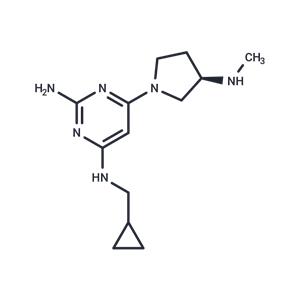
| Name | Adriforant |
| Description | Adriforant (PF-3893787,ZPL-3893797) is a competitive H4 (histamine receptor 4) antagonist that antagonizes histamine-induced phosphorylation of ERK, normalizes histamine-induced transcriptional changes in mast cells and reduces histamine-dependent Ca2+ fluxes in neurons, which alleviates itching and skin inflammation in mice |
| In vitro | Adriforant was tested in various human eosinophil functional assays, including cell shape change (IC₅₀ = 0.65 nM), CD11b expression (IC₅₀ = 4.9 nM), and actin polymerization (IC₅₀ = 1.3 nM). In a whole blood granulocyte assay (GAFS), Adriforant fully blocked imetit-induced responses at 30 nM. The binding affinity (Ki) for human H4R was 2.4 nM, with a functional Ki of 1.56 nM, indicating potent and selective H4R antagonism[1]. |
| In vivo | Adriforant was administered orally (5 mg/kg, p.o.) and intravenously (1 mg/kg, i.v.) in rats, showing good pharmacokinetics (T₁/₂ = 7 h, F = 62%). In dogs, oral dosing (10 mg/kg, p.o.) also showed favorable exposure (T₁/₂ = 24 h, F = 39%). In 7-day repeat-dose toxicity studies in rats and monkeys, no adverse effects were observed at free plasma concentrations up to 187–240× the predicted minimum human efficacious level[1]. |
| Storage | Shipping with blue ice/Shipping at ambient temperature. |
| Keywords | ZPL3893787 | ZPL 3893787 | ZPL 389 | PF-03893787 | PF03893787 | PF 3893787 | PF 03893787 | Adriforant |
| Inhibitors Related | Undecane | Betahistine mesylate | Histamine dihydrochloride | Meclizine dihydrochloride | Lidocaine | Famotidine | Sodium butanoate | Nizatidine | Alginic acid | Mianserin hydrochloride | Trazodone hydrochloride | Doxepin hydrochloride |
| Related Compound Libraries | Bioactive Compound Library | ReFRAME Related Library | Neurotransmitter Receptor Compound Library | Drug Repurposing Compound Library | Immunology/Inflammation Compound Library | Clinical Compound Library | Bioactive Compounds Library Max | GPCR Compound Library |


 United States