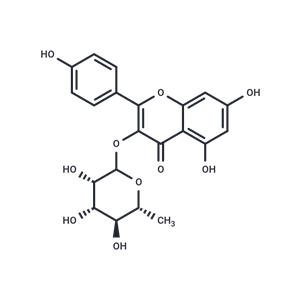
| Name | Afzelin |
| Description | Afzelin (Kaempferol-3-O-rhamnoside) exhibits several cellular activities such as DNA-protective, antibacterial, antioxidant, anti-inflammatory, and UV-absorbing properties, potentially protecting human skin from UVB-induced damage through a combination of UV-absorbing and cellular actions. Afzelin mitigates mitochondrial damage, promotes mitochondrial biogenesis, and reduces levels of mitophagy-related proteins, parkin and PTEN-induced putative kinase 1. |
| In vitro | Therefore, in this study, we investigated the protective effects of Afzelin, one of the flavonoids, against UV irradiation in human keratinocytes and epidermal equivalent models. Spectrophotometric measurements revealed that the Afzelin extinction maxima were in the UVB and UVA range, and UV transmission below 376 nm was <10%, indicating UV-absorbing activity of Afzelin. In the phototoxicity assay using the 3T3 NRU phototoxicity test (3T3-NRU-PT), Afzelin presented a tendency to no phototoxic potential. In addition, in order to investigate cellular functions of Afzelin itself, cells were treated with Afzelin after UVB irradiation. In human keratinocyte, Afzelin effectively inhibited the UVB-mediated increase in lipid peroxidation and the formation of cyclobutane pyrimidine dimers. Afzelin also inhibited UVB-induced cell death in human keratinocytes by inhibiting intrinsic apoptotic signaling. Furthermore, Afzelin showed inhibitory effects on UVB-induced release of pro-inflammatory mediators such as interleukin-6, tumor necrosis factor-α±, and prostaglandin-E2 in human keratinocytes by interfering with the p38 kinase pathway. Using an epidermal equivalent model exposed to UVB radiation, anti-apoptotic activity of Afzelin was also confirmed together with a photoprotective effect at the morphological level[1] |
| Storage | keep away from direct sunlight,store at low temperature | Shipping with blue ice/Shipping at ambient temperature. |
| Solubility Information | Ethanol : 12 mg/mL (27.75 mM), Sonication is recommended.
|
| Keywords | TNF-α | PTEN-induced kinase 1 (PINK1) | PTEN | ProstaglandinReceptor | Prostaglandin Receptor | Phosphatase and tensin homolog | PGE | p38MAPK | p38 MAPK | p38 | MMAC1 | MitochondrialMetabolism | Mitochondrial Metabolism | Inhibitor | inhibit | Bacterial | Autophagy | Afzelin |
| Inhibitors Related | Neomycin sulfate | Aceglutamide | Hemin | D(+)-Raffinose pentahydrate | Guanidine hydrochloride | Sulfamethoxazole sodium | Terbinafine hydrochloride | Hydroxychloroquine | Hyaluronic acid sodium (MW 20 kDa) | Dimethyl sulfoxide | Sodium diacetate | Sodium bicarbonate |
| Related Compound Libraries | Polyphenolic Natural Product Library | Flavonoid Natural Product Library | Bioactive Compound Library | Pain-Related Compound Library | Traditional Chinese Medicine Monomer Library | Selected Plant-Sourced Compound Library | Miao medicine Compound Library | Anti-Inflammatory Traditional Chinese Medicine Compound Library | Anti-Aging Compound Library | Bitter Compound library | Bioactive Compounds Library Max | Ancient Chinese Classical Formulas Compound Library |


 United States