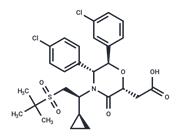
| Name | AM-2099 |
| Description | AM-2099 is a selective voltage-gated sodium channel Nav1.7 inhibitor used in pain research. |
| In vitro | AM-2099 is more than 100-fold selective over Nav1.3, Nav1.4, Nav1.5, and Nav1.8, while lower levels of selectivity are observed against Nav1.1, Nav1.2, and Nav1.6. AM-2099 demonstrates low affinity for hERG (>30 µM) and does not show greater than 50% inhibition against a panel of 100 kinases (1 µM) and a broad CEREP panel (10 µM). In heterologous cells, comparable inhibition is observed across human, mouse, dog, and cynomolgus monkey NaV1.7 with reduced activity against rat NaV1.7.[1] |
| In vivo | AM-2099 demonstrates a dose-dependent increase in plasma exposure with a concomitant dose-dependent reduction in scratching bouts compared to vehicle-treated animals, with a statistically significant reduction observed at the 60 mg/kg dose.
AM-2099 demonstrates a favorable pharmacokinetic profile in rat and dog. In rats AM-2099 shows low total clearance and moderate Vdss and half-life. However, when dosed in dogs AM-2099 shows very low clearance, a low Vdss and long halflife (18 h).[1] |
| Storage | Powder: -20°C for 3 years | In solvent: -80°C for 1 year
Shipping with blue ice/Shipping at ambient temperature. |
| Solubility Information | 10% DMSO+40% PEG300+5% Tween-80+45% Saline : 3.3 mg/mL (7.07 mM), Sonication is recommended.
DMSO : 120 mg/mL (257.26 mM), Sonication is recommended.
|
| Keywords | rat Nav1.7 | mouse Nav1.7 | human Nav1.7 | AM-2099 | AM 2099 |
| Inhibitors Related | Phenytoin sodium | Procaine | Ranolazine dihydrochloride | Tetracaine hydrochloride | Lidocaine | Safinamide | Permethrin | Valproic Acid | L-Aspartic aicd sodium | Lidocaine hydrochloride | Mebeverine hydrochloride | Dibucaine |



 United States