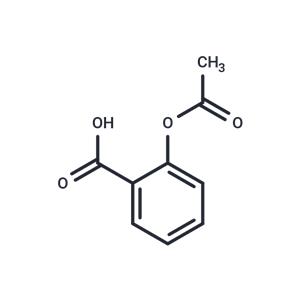
| Name | Aspirin |
| Description | Aspirin is an orally active, selective, and irreversible inhibitor of COX-1 and COX-2 with IC₅₀ values of 5 and 210 μg/mL, respectively. It induces apoptosis, inhibits NF-κB activation and platelet prostaglandin synthesis, thereby preventing thrombosis. Additionally, it acts as a histone deacetylase inhibitor that upregulates p21, exhibiting anti-inflammatory, antipyretic, analgesic, and anti-platelet aggregation activities. Aspirin is commonly used to induce gastric ulcer models. |
| Cell Research | Chondrocytes are isolated from articular cartilage of donors with no articular disease. Unstimulated and interleukin 1 (IL-1) stimulated chondrocytes are used as models to study the effects of drugs on COX-1 and COX-2. Cells are incubated with vehicle or drugs (Asprin); supernatants are removed and the level of prostaglandin E2 (PGE2) in each sample is determined by enzyme immunoassay. IC50s are calculated from the reduction in PGE2 content by different concentrations of the test substance by linear regression analysis[5]. |
| In vitro | METHODS: Colorectal cancer cells SW620, LoVo, RKO and DLD-1 were treated with Aspirin (2 mM) and Cisplatin (5-80 µM) for 48 h. Cell viability was detected by MTT assay.
RESULTS: The combination more effectively reduced the viability of colon cancer cells. The combination treatment resulted in a significant decrease in the IC50 value of Cisplatin. [1]
METHODS: Osteoblasts MG-63 were treated with Aspirin (1-1000 µM) for 24 h. Cell cycle was detected by Flow cytometry.
RESULTS: Aspirin at doses of 1, 10, and 20 µM had no significant effect on the MG-63 cell cycle after 24 h of treatment. However, the percentage of cells in G0/G1 phase was significantly increased at doses of 100 and 1000 µM. [2] |
| In vivo | METHODS: To assay in vivo antitumor activity, Aspirin (100 mg/kg administered by gavage once daily) and Cisplatin (3 mg/kg administered intraperitoneally every three days) were administered to nude mice bearing LoVo xenografts for 18 days.
RESULTS: Aspirin and Cisplatin synergistically inhibited the growth of colon cancer grafts in nude mice, and these effects were exerted, at least in part, through modulation of the PI3K-Akt, RAF-MEK-ERK, and NF-κB/COX-2 signaling pathways. [1] |
| Storage | Powder: -20°C for 3 years | In solvent: -80°C for 1 year
Shipping with blue ice/Shipping at ambient temperature. |
| Solubility Information | 10% DMSO+90% Saline : 1.81 mg/mL (10.05 mM), Solution.
H2O : 1.81 mg/mL (10.05 mM), Sonication and heating are recommended.
DMSO : 245 mg/mL (1359.9 mM), Sonication is recommended.
|
| Keywords | VirusProtease | Virus Protease | prostaglandin synthetase | platelet | p38 MAPK | Nuclear factor-κB | Nuclear factor-kappaB | NF-κB | Mitophagy | Mitochondrial Autophagy | Inhibitor | inhibit | inflammation | fever | Cyclooxygenase | COX-2 | COX-1 | COX | coronary artery | cerebrovascular thrombosis | Caspase | cancer | Autophagy | Aspirin | Apoptosis | Antipyretic effect |
| Inhibitors Related | Stavudine | Aceglutamide | Hemin | Tamoxifen | Guanidine hydrochloride | Hydroxychloroquine | Paeonol | Thymidine | Naringin | Trometamol | Alginic acid | Sildenafil citrate |
| Related Compound Libraries | Highly Selective Inhibitor Library | Anti-Neurodegenerative Disease Compound Library | Pain-Related Compound Library | Bioactive Compound Library | Anti-Cancer Clinical Compound Library | Anti-Viral Compound Library | Inhibitor Library | FDA-Approved Drug Library | Bitter Compound library | Anti-Aging Compound Library | Immunology/Inflammation Compound Library | Anti-Cancer Drug Library |

 United States