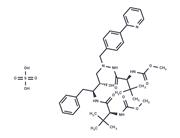
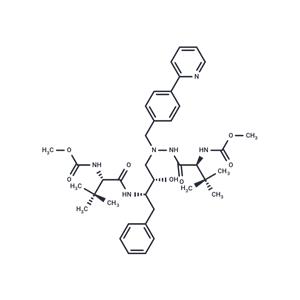
| Name | Atazanavir |
| Description | Atazanavir (BMS-232632)(BMS-232632) is an highly effective HIV-1 protease inhibitor. |
| Cell Research | U251, T98 g, and LN229 glioblastoma cell lines are exposed to increasing concentrations of nelfinavir and atazanavir. Cells cultured in 96-well plates are treated with drugs for 48 h, and cell growth and survival are determined by conventional MTT assay.(Only for Reference) |
| Kinase Assay | Protease assays: To determine the inhibition constants (Ki) for each Prt inhibitor, purified HIV-1 RF wild-type Prt (2.5 nM) is incubated at 37 ℃ with 1 μM to 15 μM fluorogenic substrate in reaction buffer (1 M NaCl, 1 mM EDTA, 0.1 M sodium acetate [pH 5.5], 0.1% polyethylene glycol 8000) in the presence or absence of Atazanavir. Cleavage of the substrate is quantified by measuring an increase in fluorescent emission at 490 nM after excitation at 340 nM using a Cytofluor 4000. Reactions are carried out using 1.36 μM, 1.66 μM, 2.1 μM, 3.0 μM, 5.0 μM, or 15 μM substrate in the presence of five concentrations of Atazanavir (1.25 nM to 25 nM). Substrate cleavage is monitored at 5-min intervals for 30 min. Cleavage rates are then determined for each sample at early time points in the reaction, and Ki values are determined from the slopes of the resulting Michaelis-Menten plots. |
| In vitro | Atazanavir has potent in vitro activity with 50 and 90% effective concentrations(EC50) of 2-5 nM and 9-15 nM respectively against wild type virus[1]. Atazanavir is able to potently induce endoplasmic reticulum (ER) stress response in malignant glioma cells, as indicated by elevated levels of GRP78 and CHOP, and activation of caspase-4, which leads to cell death[3]. |
| In vivo | Atazanavir has excellent oral bioavailability in the range of 60-70%[1]. |
| Storage | Shipping with blue ice/Shipping at ambient temperature. |
| Solubility Information | Ethanol : 32 mg/mL (45.4 mM), Sonication is recommended.
DMSO : 250 mg/mL (354.68 mM), Sonication is recommended.
H2O : < 1 mg/mL (insoluble or slightly soluble)
|
| Keywords | SARS-CoV | SARSCoV | SARS coronavirus | P-gp (P-glycoprotein) | P-gp | Pgp | P-glycoprotein | Multidrug resistance protein 1 | MDR1 | Inhibitor | inhibit | Human immunodeficiency virus | HIVProtease | HIV Protease | HIV | Cytochrome P450 | CYPs | Cluster of differentiation 243 | CD243 | BMS232632 | BMS 232632 | Atazanavir | ABCB1 |
| Inhibitors Related | Sucrose | Aceglutamide | Nicotinamide riboside malate | DL-Lysine | D(+)-Raffinose pentahydrate | Guanidine hydrochloride | Formamide | Glycerol | Thymidine | Corn starch | Hyaluronic acid sodium (MW 20 kDa) | Gluconate Calcium |
| Related Compound Libraries | Highly Selective Inhibitor Library | Failed Clinical Trials Compound Library | Anti-Neurodegenerative Disease Compound Library | EMA Approved Drug Library | Anti-Cancer Clinical Compound Library | Drug Repurposing Compound Library | Inhibitor Library | FDA-Approved Drug Library | Anti-Cancer Approved Drug Library | Immunology/Inflammation Compound Library | Anti-Aging Compound Library | Anti-Cancer Drug Library |


 United States