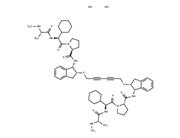
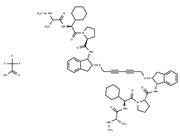
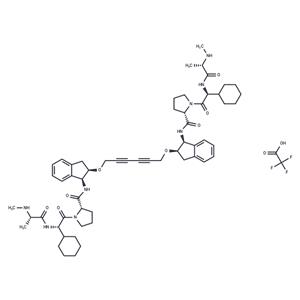
| Name | AZD5582 TFA |
| Description | AZD5582 TFA is a potent IAP antagonist that binds to the BIR3 domain of cIAP1, cIAP2, and XIAP with IC50 values of 15, 21, and 15 nM, respectively.AZD5582 TFA induces apoptosis. |
| In vitro | AZD5582 TFA (20 nM; 48 h; H1975 NSCLC cell line) in collaboration with IFNγ or viral double-stranded RNA (dsRNA), suppresses cell viability and even induces cell death in H1975 NSCLC cells.[2]
AZD5582 TFA (20 nM; 17 or 25 h) induces cIAP-1 downregulation, promotes RIPK1 activation (an upstream regulator of caspase-8), and initiates the activation of both extrinsic (caspase-8) and intrinsic (caspase-9) apoptotic pathways, resulting in the cleavage of caspase-3 and caspase-7.[2]
AZD5582 TFA (20 nM; 48 h; H1975 NSCLC cell line) is involved in apoptosis due to induction of cell death and active caspase-3/8 activities by AZD5582 TFA and IFNγ co-treatment in HCC827 NSCLC cells.[2] |
| In vivo | AZD5582 TFA (0.1-3.0 mg/kg; i.v.; once a week; 2 weeks; MDA-MB-231 xenograft-bearing mice) triggers cIAP1 degradation and caspase 3 cleavage within tumor cells. Following a two-week treatment, significant tumor resolution is observed. Upon administering a medium dose of 0.5 mg/kg AZD5582 TFA to mice, cIAP1 degradation occurs upon administration, although it takes some time for the apoptosis-inducing effects to manifest.[1] |
| Storage | Shipping with blue ice/Shipping at ambient temperature. |
| Solubility Information | DMSO : 50 mg/mL (44.27 mM), Sonication is recommended.
|
| Keywords | IAP | AZD5582 TFA | apoptosis | 1258392-53-8 free base | 1258392-53-8 |
| Inhibitors Related | Stavudine | Aceglutamide | Urea | Tamoxifen | Cysteamine hydrochloride | Metronidazole | Citric Acid Triammonium | Formamide | Dimethyl phthalate | Alginic acid | Sodium Molybdate | Sildenafil citrate |
| Related Compound Libraries | Apoptosis Compound Library | Bioactive Compound Library | Inhibitor Library | Bioactive Compounds Library Max | Fluorochemical Library |


 United States