Product Number: B040144
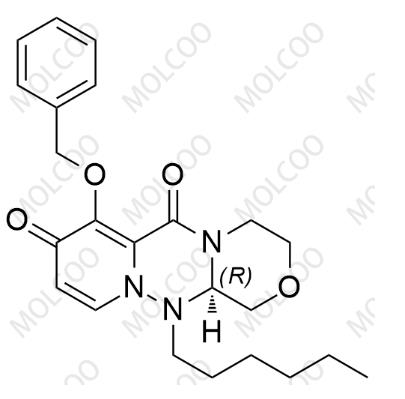
English Name: Baloxavir Impurity 144
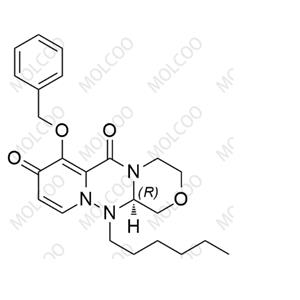
English Alias: (R)-7-(benzyloxy)-12-hexyl-3,4,12,12a-tetrahydro-1H-[1,4]oxazino[3,4-c]pyrido[2,1-f][1,2,4]triazine-6,8-dione
CAS Number: None
Molecular Formula: C₂₃H₂₉N₃O₄
Molecular Weight: 411.49
As an impurity of Baloxavir, this compound has the following advantages:
Well-defined with distinct chirality: Contains (R) chiral center, [1,4]oxazino[3,4-c]pyrido[2,1-f][1,2,4]triazine fused ring system, 7-benzyloxy, 12-hexyl, and 6,8-dione groups. Unlike baloxavir (anti-influenza drug with cap-like structure), its benzyloxy hydrophobicity, hexyl lipophilicity, and dione polarity create significant differences, enabling precise differentiation via HPLC/chiral chromatography as a specific marker;
High stability and traceability: Rigid fused ring structure and stability of ether/keto groups ensure neutral-condition stability. As a byproduct from incomplete cyclization or substituent deviation in synthesis, it directly reflects fused ring formation efficiency, improving process tracing accuracy;
High detection sensitivity: Polycyclic conjugation shows strong UV absorption (240-280nm), combined with m/z 412 [M+H]⁺ enabling ppb-level analysis via LC-MS, compatible with anti-influenza polycyclic impurity systems.
Pharmaceutical quality control: Used as an impurity reference standard to quantify Baloxavir Impurity 144 in APIs, ensuring compliance with specific impurity limits in quality standards;
Synthesis optimization: Optimizing cyclization conditions (catalyst selectivity) by monitoring impurity levels to reduce byproducts and enhance target specificity;
Method validation: Verifying accuracy and specificity of baloxavir impurity assays to ensure effective separation and quantification.
Baloxavir’s structure is based on a complex polycyclic system, synthesized via multi-step cyclization and substitution. Deviations in ring fusion or incomplete benzyloxy deprotection may generate analogs like Baloxavir Impurity 144. Due to structural similarity affecting viral target binding, its residues impact baloxavir quality and safety, making control critical for assurance.
Current research focuses on:
Analytical method validation: Developing UPLC assays with C18 columns for baseline separation, achieving 0.05 ppb detection limits;
Cyclization kinetics: Studying impurity formation under varying cyclization reagents to clarify ring fusion-substituent correlation;
Control strategies: Optimizing intermediate purity to keep impurity levels below 0.1% and enhance API quality;
Structural confirmation: Using ¹H/¹³C-NMR and MS/MS to verify chiral center/substituent positions, distinguishing from baloxavir for authoritative identification




 China
China