Product Number: B026093
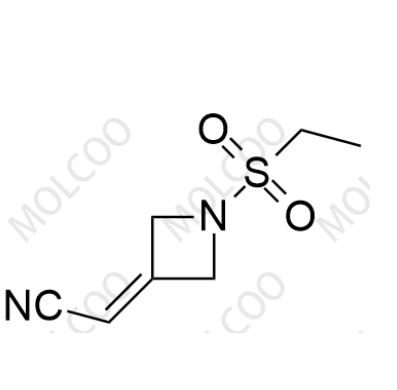
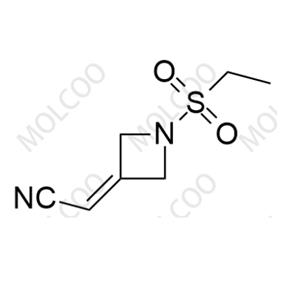
English Name: Baricitinib Impurity 93
English Alias: 2-(1-(ethylsulfonyl)azetidin-3-ylidene)acetonitrile
CAS Number: 1187595-85-2
Molecular Formula: C₇H₁₀N₂O₂S
Molecular Weight: 186.23
As a sulfur-containing heterocyclic impurity of baricitinib, the research advantages of this compound lie in:
Analyzing the by-product formation mechanism of sulfonylation and cyclization reactions during baricitinib synthesis to optimize processes for controlling sulfur-containing ylidene impurity generation;
Serving as a reference standard containing sulfonyl and nitrile groups to provide a standard substance for detecting polar heterocyclic impurities in drugs, improving the quantitative accuracy of methods such as LC-MS;
Helping study the impact of sulfur substituents and imine structures on drug stability and toxicological properties to provide a scientific basis for impurity control strategies.
Drug Development: Used as an impurity reference standard to identify and quantify Impurity 93 in baricitinib preparations, evaluating the purity of APIs and formulations;
Quality Control: Acting as a standard substance to validate the sensitivity of detection methods (e.g., HPLC or LC-MS), ensuring the impurity content meets ICH guideline requirements during production;
Toxicological Research: Assisting in evaluating the potential genotoxicity of sulfur-containing ylidene impurities to provide data support for drug safety evaluation.
Baricitinib is a JAK inhibitor. If the sulfonylation reagent is excessive or the cyclization reaction conditions are out of control during its synthesis, azetidine impurities containing ethylsulfonyl groups (such as Impurity 93) are easily generated. Since sulfur-containing compounds may have potential oxidative toxicity and imine structures easily react with biological macromolecules, research on this impurity is a key link in baricitinib quality control and safety assessment.
Current research focuses on:
Synthesis Methods: Developing high-purity synthesis processes for Impurity 93 to solve the purification challenges of sulfur-containing heterocyclic compounds and meet the needs of toxicological research;
Detection Technologies: Establishing trace detection methods (detection limits reach ppb level) for this impurity using ultra-high-performance liquid chromatography-tandem mass spectrometry (UPLC-MS/MS) technology;
Toxicological Evaluation: Studying the potential mutagenicity of sulfonyl and nitrile structures through in vitro Ames tests and animal models;
Process Control: Analyzing the inducements (such as raw material residues, reaction temperature) of sulfonylation reactions to optimize the synthesis route and reduce the generation of this impurity.


 China
China