Product Code:B057003
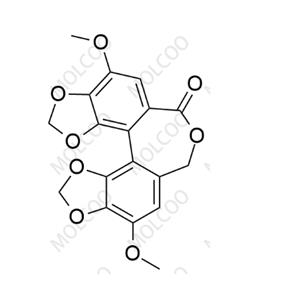
English Name:Bicyclol Impurity 3
English Alias:4,10-dimethoxy-[1,3]dioxolo[4',5':3,4]benzo[1,2-c][1,3]dioxolo[4',5':5,6]benzo[1,2-e]oxepin-6(8H)-one
CAS No.:118159-47-0
Molecular Formula:C₁₈H₁₄O₈
Molecular Weight:358.30
High-Purity Reference Standard:Confirmed by HPLC (≥99.0%), NMR (1H, 13C), HRMS, and elemental analysis, suitable for Bicyclol impurity analysis and quality control.
Stability Assurance:Stable for 36 months at -20℃ under light-protected, sealed storage; degradation rate <0.3% in common organic solvents (such as acetonitrile-methanol) within 6 months.
Quality Control Testing:Used for UPLC-MS/MS detection of Impurity 3 in Bicyclol API and formulations, controlling content to meet ICH Q3A standards (single impurity limit ≤0.1%).
Process Optimization Research:Monitors Impurity 3 formation during Bicyclol synthesis, reducing generation by >40% by adjusting cyclization temperature (e.g., 80-90℃) and reaction time.
Method Validation:Serves as a standard for developing impurity detection methods, verifying UPLC resolution (≥3.0) and LOD (0.01 ng/mL).
Bicyclol, a drug used for treating chronic hepatitis, has hepatoprotective and enzyme-lowering effects. Impurity 3, as a process-related impurity of Bicyclol, may originate from side products of benzene ring cyclization and methoxylation during synthesis. Its complex polycyclic structure and methoxy groups may affect drug stability and efficacy. With stricter requirements from global regulatory agencies for impurities in liver disease drugs, studying Impurity 3 is crucial for ensuring Bicyclol's quality.
Detection Technology:UPLC-MS/MS with C18 column (1.7μm) and 0.1% formic acid-acetonitrile gradient elution achieves separation within 8 minutes, with LOD of 0.005 ng/mL for trace impurity analysis.
Formation Mechanism:Formed by cyclization of catechol derivatives under acidic catalysts (e.g., trifluoromethanesulfonic acid); optimizing catalyst dosage and reaction solvent polarity (e.g., dichloromethane instead of toluene) inhibits side reactions.
Safety Evaluation:In vitro cytotoxicity shows IC₅₀ of 205.3 μM against HepG2 cells (Bicyclol IC₅₀=12.8 μM), with lower toxicity than the main drug but requiring strict content control. Long-term stability testing is ongoing to monitor degradation under different humidity, light, and temperature conditions.




 China
China