Synonym
SIGLEC10, MGC126774, PRO940, Siglec10, SLG2
Source
Biotinylated Human Siglec-10, His,Avitag (SI0-H82E3) is expressed from human 293 cells (HEK293). It contains AA Met 17 - Thr 546 (Accession # Q96LC7-1).
Predicted N-terminus: Met 17
Request for sequence
Molecular Characterization

Other Tags and Version Biotin & Other Labeled Version
This protein carries a polyhistidine tag at the C-terminus, followed by an Avi tag (Avitag™).
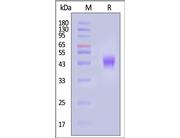
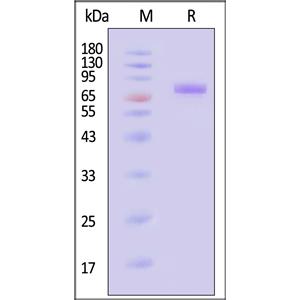
The protein has a calculated MW of 61.8 kDa. The protein migrates as 65-85 kDa when calibrated against Star Ribbon Pre-stained Protein Marker under reducing (R) condition (SDS-PAGE) due to glycosylation.
Labeling
Biotinylation of this product is performed using Avitag™ technology. Briefly, the single lysine residue in the Avitag is enzymatically labeled with biotin.
Protein Ratio
Passed as determined by the HABA assay / binding ELISA.
Purity
>95% as determined by SDS-PAGE.
Formulation
Lyophilized from 0.22 μm filtered solution in PBS with Arginine, pH7.4 with trehalose as protectant.
Contact us for customized product form or formulation.
Reconstitution
Please see Certificate of Analysis for specific instructions.
For best performance, we strongly recommend you to follow the reconstitution protocol provided in the CoA.
Storage
For long term storage, the product should be stored at lyophilized state at -20°C or lower.
Please avoid repeated freeze-thaw cycles.
This product is stable after storage at:
-20°C to -70°C for 12 months in lyophilized state;
-70°C for 3 months under sterile conditions after reconstitution.
Background
The siglecs (sialic acid-binding Ig-like lectins) are a distinct subset of the Ig superfamily with adhesion-molecule-like structure. We describe here a novel member of the siglec protein family that shares a similar structure including five Ig-like domains, a transmembrane domain, and a cytoplasmic tail containing two ITIM-signaling motifs. Siglec-10 was identified through database mining of an asthmatic eosinophil EST library. The Siglec-10-VAP-1 interaction seems to mediate lymphocyte adhesion to endothelium and has the potential to modify the inflammatory microenvironment via the enzymatic end products.



 China
China