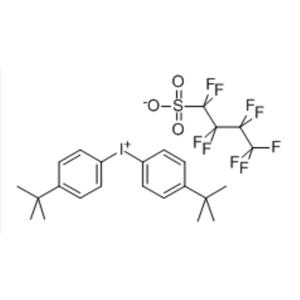
Product Name: Bis(4-tert-butylphenyl)iodonium perfluoro-1-butanesulfonate
Aliases: Bis(4-tert-butylphenyl)iodonium nonaflate; Bis(4-tert-butylphenyl)iodonium perfluorobutanesulfonate; (4-tert-Butylphenyl)2I(1+)·C4F9SO3(1-); Iodonium, bis(4-(1,1-dimethylethyl)phenyl)-, 1,1,2,2,3,3,4,4,4-nonafluorobutanesulfonate
Molecular Formula: C₂₄H₂₈F₉IO₃S
Molecular Weight: 696.43 g/mol
Physical State (20°C): Solid, appearing as white to off-white crystalline powder
Melting Point: 110–114°C (Typical)
Solubility: Insoluble in water; soluble in organic solvents such as acetone, methanol, ethanol, dichloromethane, tetrahydrofuran (THF), and acetonitrile
Stability: Stable under normal temperature and pressure; sensitive to light, should be protected from strong light irradiation; incompatible with strong reducing agents and strong bases
Storage Conditions: Store in a cool, dry and dark place; keep sealed to avoid moisture and light
Appearance: High-purity products are white crystalline powder with uniform particle size and no visible impurities
It is a high-efficiency cationic photoinitiator, mainly used in UV-curable cationic polymerization systems, such as UV-curable coatings, inks, adhesives, and photoresists.
It is widely applied in the microelectronics industry, serving as a photoinitiator for photoresists in semiconductor manufacturing, PCB (Printed Circuit Board) processing, and microfabrication.
It is used in the synthesis of UV-curable functional materials, helping to improve curing speed, surface curing effect, and product mechanical properties.
It is applied in the field of optoelectronic materials, used as an auxiliary reagent for photopolymerization reactions in OLED and other optoelectronic device manufacturing.
It is used in the research and development of high-performance UV-curable materials, such as anti-corrosion coatings, high-hardness coatings, and optical materials.