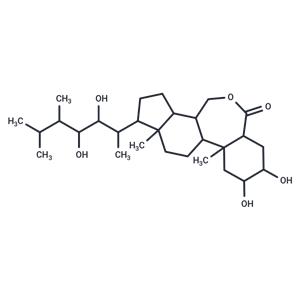
| Name | Brassinolide |
| Description | Brassinolide (Brassin lactone) is a plant hormone isolated from rapeseed (Brassica napus) promoting stem elongation and cell division. |
| Cell Research | Brassinolide is dissolved in DMSO and stored, and then diluted with appropriate medium before use[2]. MTT method is used to detect the resistant factor of resistant cell line and the reversing fold after addition of Brassinolide. The intracellular accumulation of rhodamine 123, a fluorescent dye transported by P-glycoprotein is detected by flow cytometry, the catalytic activity of topoisomerase II is assessed by Sulliven method to find the effect of Brassinolide on resistance. The protein expression of p53 is measured using Western blotting in the sensitive cells and resistant cells to explore the effect of Brassinolide[2]. |
| In vitro | Brassinolide, a plant sterol isolated from rape pollen (Brassica napus L.), demonstrates both growth-modulating properties and potential anti-cancer activities. In PC-3 cells, Brassinolide induces cytotoxicity in a time and concentration-dependent manner, primarily through apoptosis. This is evidenced by increased Caspase-3 activity, and a decrease in the anti-apoptotic protein Bcl-2, as confirmed by various microscopy techniques and flow-cytometric analysis. These findings position Brassinolide as a promising candidate for prostate cancer treatment[1]. Furthermore, Brassinolide shows efficacy in reversing multidrug resistance (MDR) in the human T lymphoblastoid cell line CCRF-VCR, which develops resistance through exposure to vincristine (VCR). Treatment with Brassinolide at concentrations between 0.001-10 μg/mL partially reverses this resistance and enhances the intracellular accumulation of rhodamine 123, indicating a reduction in drug efflux mediated by P-glycoprotein. Despite showing no change in topoisomerase II activity, Brassinolide treatment normalizes the elevated levels of p53 protein in resistant cells to those seen in sensitive cells. This suggests that modulating p53 expression could be a mechanism by which Brassinolide reverses MDR[2]. |
| Storage | keep away from moisture | Powder: -20°C for 3 years | In solvent: -80°C for 1 year | Shipping with blue ice/Shipping at ambient temperature. |
| Solubility Information | DMSO : 60 mg/mL (124.82 mM), Sonication is recommended.
|
| Keywords | plant growth modulator | Brassinolide | Apoptosis |
| Inhibitors Related | Stavudine | Aceglutamide | Tamoxifen | Urea | Cysteamine hydrochloride | Metronidazole | Citric Acid Triammonium | Formamide | Dimethyl phthalate | Alginic acid | Sodium Molybdate | Dextran sulfate sodium salt (MW 5000) |
| Related Compound Libraries | Anti-Tumor Natural Product Library | Apoptosis Compound Library | Pesticide Compound Library | Medicinal and aromatic plants natural product library | Traditional Chinese Medicine Monomer Library | Bioactive Compound Library | Selected Plant-Sourced Compound Library | Natural Product Library | Tobacco Monomer Library | Natural Product Library for HTS | Bioactive Compounds Library Max | Bioactive Lipid Compound Library |


 United States