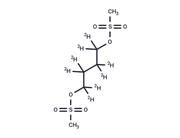
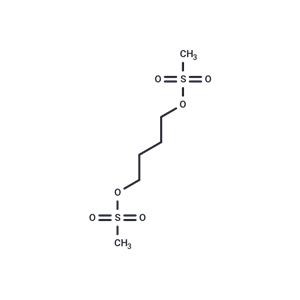
| Name | Busulfan |
| Description | Busulfan is an alkylating antineoplastic agent derived from dimethane sulfonate, with cytotoxic and immunosuppressive properties. It primarily acts by forming carbonium ions in vivo, which induce cross-linking between DNA strands or between DNA and proteins, leading to DNA damage, inhibition of DNA replication, and suppression of RNA transcription. In addition, Busulfan can inhibit thioredoxin reductase and induce apoptosis. It is commonly used as a myeloablative agent in preconditioning regimens for bone marrow transplantation and can also be used to establish anemia models. |
| In vitro | Mice transplanted with busulfan exhibit slow and incomplete lymphoid engraftment. Mice treated with busulfan demonstrate a significant increase in apoptosis and a reduction in testicular weight. In NOD/SCID mice, busulfan treatment combined with irradiation achieves a detection sensitivity similar to that of limiting dilution assays. A dose-dependent lymphoid tissue reconstitution is provided in mice with 20 mg/kg to 100 mg/kg of busulfan. At 40 mg/kg, busulfan induces the maximum number of apoptotic cells while minimizing the number of necrotic cells. |
| In vivo | Busulfan, an alkylating agent that induces DNA damage through cross-linking DNA with DNA and proteins, triggers senescence in normal human diploid WI38 fibroblast cells via a cascade mediated by extracellular signal-regulated kinase (Erk) and p38 mitogen-activated protein kinase (p38 MAPK), independent of the p53-DNA damage pathway. Busulfan causes a transient reduction in glutathione levels, followed by a sustained increase in ROS production. The hypophosphorylation of Rb induced by Busulfan inhibits the expression of PCNA in testicular cells, preventing apoptosis of spermatogonial stem cells. Moreover, while Busulfan reduces the frequency of cobblestone area-forming cells, it does not significantly increase apoptosis in hematopoietic stem cells (HSC)-like cells and progenitor cells with similar phenotypes. Busulfan suppresses the hematopoietic function of HSC-like cells and progenitor cells through an apoptosis-dependent mechanism. Additionally, Busulfan-induced senescence in bone marrow hematopoietic cells correlates with a time-dependent increase in the expression of p16Ink4a and p19Arf. |
| Storage | Shipping with blue ice/Shipping at ambient temperature. |
| Solubility Information | Ethanol : < 1 mg/mL (insoluble or slightly soluble)
DMSO : 50.00 mg/mL (203.00 mM), Sonication is recommended.
10% DMSO+40% PEG300+5% Tween-80+45% Saline : 3.00 mg/mL (12.18 mM)
|
| Keywords | Inhibitor | inhibit | DNAAlkylator | DNAAlkylation | DNA Alkylator/Crosslinker | DNA Alkylator | DNA Alkylation | Crosslinker | Busulfan | Apoptosis |
| Inhibitors Related | Stavudine | Aceglutamide | Urea | Tamoxifen | Cysteamine hydrochloride | Metronidazole | Citric Acid Triammonium | Formamide | Dimethyl phthalate | Alginic acid | Sodium Molybdate | Sildenafil citrate |
| Related Compound Libraries | Pesticide Compound Library | Failed Clinical Trials Compound Library | Anti-Cancer Clinical Compound Library | Drug Repurposing Compound Library | Inhibitor Library | Anti-Cancer Approved Drug Library | FDA-Approved Drug Library | Immunology/Inflammation Compound Library | Anti-Aging Compound Library | Bioactive Compounds Library Max | Anti-Cancer Drug Library | Anti-Cancer Active Compound Library |


 United States