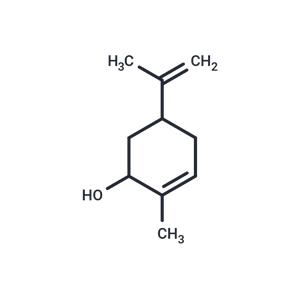
| Name | Carveol |
| Description | (-)-Carveol ((-)-Carveol, mixture of isomers), mixture of isomers is a monocyclic monoterpenic alcohol, present in essential oils of plant species such as Cymbopogon giganteus, Illicium pachyphyllum and in spices such as Carum carvi (cumin). |
| In vitro | (-)-Carveol exhibited a significant vasorelaxant effect on KCl and 5-HT-induced contractions, obtaining EC50 values of 344.25 ± 8.4 and 175.82 ± 4.05 μM, respectively. The participation of calcium channels in the relaxation produced by (-)-carveol was analyzed using vessels pre-incubated with (-)-carveol (2000 μM) in a calcium-free medium, where the induction of contractions was abolished. The vasorelaxant effect of (-)-carveol on HUAs was reduced by tetraethylammonium (TEA), which increased the (-)-carveol EC50 to 484.87 ± 6.55 μM. The present study revealed that (-)-carveol possesses a vasorelaxant activity in HUAs, which was dependent on the opening of calcium and potassium channels[1]. |
| In vivo | (-)-Carveol has low toxicity, with a lethal dose 50% (LD50) equal to or greater than 2,500 mg/kg according to OECD guide no 423. In all gastric ulcer induction methods evaluated, (-)-Carveol (25, 50, 100 and 200 mg/kg, p.o.) significantly reduced the ulcerative lesion in comparison with the respective control groups. In the experimental protocol of pylorus ligation-induced gastric ulcer, (-)-Carveol (100 mg/kg) reduced (p < 0.001) the volume of gastric secretion in both routes (oral and intraduodenal). The previous administration of blockers NEM (sulfhydryl groups blocker), L-NAME (nitric oxide synthesis inhibitor), glibenclamide (KATP channel blocker) and indomethacin (cyclo-oxygenase inhibitor), significantly reduced the gastroprotection exercised by (-)-Carveol, suggesting the participation of these pathways in its gastroprotective activity. In addition, treatment with (-)-Carveol (100 mg/kg) increased (p < 0.001) mucus adhered to the gastric wall. Treatment also increased (p < 0.001) levels of reduced glutathione (GSH), superoxide dismutase (SOD) and interleukin-10 (IL-10). It also reduced (p < 0.001) malondialdehyde (MDA), myeloperoxidase (MPO), interleukin-1 beta (IL-1β) and tumor necrosis factor-alpha (TNF-α) levels[2]. |
| Storage | Powder: -20°C for 3 years | In solvent: -80°C for 1 year
Pure form: -20°C for 3 years | In solvent: -80°C for 1 year
Shipping with blue ice/Shipping at ambient temperature. |
| Solubility Information | 10% DMSO+40% PEG300+5% Tween 80+45% Saline : 2 mg/mL (13.14 mM), Sonication is recommended.
DMSO : 50 mg/mL (328.45 mM), Sonication is recommended.
|
| Keywords | Human Endogenous Metabolite | EndogenousMetabolite | Endogenous Metabolite | Carveol, mixture of isomers | Carveol |
| Inhibitors Related | Sucrose | Aceglutamide | Nicotinamide riboside malate | DL-Lysine | D(+)-Raffinose pentahydrate | Guanidine hydrochloride | Malic acid | Formamide | Glycerol | Thymidine | Corn starch | Gluconate Calcium |
| Related Compound Libraries | Terpene Natural Product Library | Traditional Chinese Medicine Monomer Library | Bioactive Compound Library | Selected Plant-Sourced Compound Library | Miao medicine Compound Library | Natural Product Library | Natural Product Library for HTS | Flavor Natural Product library | Human Endogenous Metabolite Library | Bioactive Compounds Library Max | Ancient Chinese Classical Formulas Compound Library | Food as Medicine Compound Library |


 United States