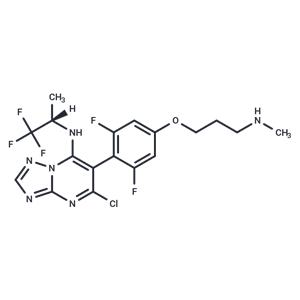
| Name | Cevipabulin |
| Description | Cevipabulin (TTI-237) is a microtubule-active antitumor compound and inhibits the binding of [3H] vinblastine to tubulin (IC50: 18-40 nM in the human tumor cell line). |
| In vitro | Cevipabulin (0-50 nM, 72 hours) exhibits significant activity (IC50s: 18-40 nM) against ovarian, breast, prostate, and cervical tumor cell lines. At low concentrations (20-40 nM), it induces sub-G1 nuclei, while concentrations above 50 nM result in a pronounced G2-M block [1]. |
| In vivo | In mice, Cevipabulin ( 5, 10, 15, and 20 mg/kg, every 4 days for 4 cycles; i.v. and p.o.) is active against human tumor xenografts and showing dose-dependent effects, with good antitumor activity at 20 and 15 mg/kg [1]. |
| Storage | 02 | Shipping with blue ice/Shipping at ambient temperature. |
| Solubility Information | DMSO : 9 mg/mL (19.36 mM), Sonication is recommended.
10% DMSO+40% PEG300+5% Tween 80+45% Saline : 1 mg/mL (2.15 mM), Sonication is recommended.
|
| Keywords | TTI237 | TTI 237 | MicrotubuleAssociated | microtubule in human tumor cells | Microtubule Associated | microtubule | Cevipabulin |
| Inhibitors Related | Flubendazole | N-Phenylbenzylamine | Mebendazole | 4-Isopropoxybenzoic acid | Pregnenolone acetate | Oxfendazole | α-Cyclodextrin | Methylene Blue trihydrate | 2-Methylthiophenothiazine | Paclitaxel | 4'-Demethylepipodophyllotoxin | Albendazole |
| Related Compound Libraries | Bioactive Compound Library | ReFRAME Related Library | Anti-Cancer Clinical Compound Library | Microtubule-Targeted Compound Library | Drug Repurposing Compound Library | Inhibitor Library | Orally Active Compound Library | Clinical Compound Library | Bioactive Compounds Library Max | Cytoskeletal Signaling Pathway Compound Library | Anti-Cancer Active Compound Library | Anti-Cancer Drug Library |


 United States