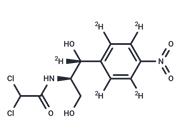
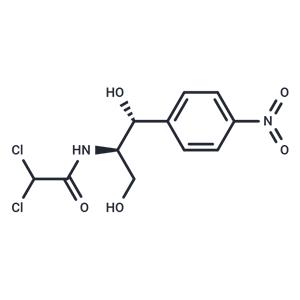
| Name | Chloramphenicol |
| Description | Chloramphenicol (Chloromycetin) is a broad-spectrum antibiotic that inhibits the biosynthesis of bacterial proteins. Chloramphenicol acts primarily on the 50S subunit of the bacterial 70S ribosome and is active against peptidyltransferases, inhibiting the formation of peptide bonds. |
| In vitro | METHODS: Human lung cancer cells A549 and H1299 were treated with Chloramphenicol (1-100 µg/mL) for 3-24 h. Cell viability was detected by MTT assay.
RESULTS: In the 3 h treatment group, the viability of A549 and H1299 cells at 100 µg/mL was 97.0±3.9% and 98.1±5.0%, respectively, and no cytotoxicity was observed. A significant reduction in cell viability was observed in the 24 h treatment group. [1]
METHODS: Mouse T cell lines A1.1 and IE5 and human T cell lines Jurkat and Jcam were stimulated with Chloramphenicol (100 nmol/L), and the DNA content was measured by Flow cytometry.
RESULTS: Chloramphenicol clearly blocked activation-induced cell death (AICD) in all four cell lines, even though these cells were activated by different stimuli. [2] |
| In vivo | METHODS: To investigate the potential to induce aplastic anemia, Chloramphenicol (2000 mg/kg) and Thiamphenicol (850 mg/kg) were administered by gavage to BALB/c mice once daily for 17 days.
RESULTS: Administration of Chloramphenicol and Thiamphenicol at hematotoxic dose levels for 17 days in BALB/c mice was associated with the development of aplastic anemia in humans, inducing reversible anemia but not chronic bone marrow aplasia. [3] |
| Storage | keep away from direct sunlight,store under nitrogen | Powder: -20°C for 3 years | Shipping with blue ice/Shipping at ambient temperature. |
| Solubility Information | H2O : 1 mg/mL (3.09 mM), Sonication is recommended.
Ethanol : 60 mg/mL (185.68 mM), Sonication is recommended.
10% DMSO+40% PEG300+5% Tween 80+45% Saline : 5 mg/mL (15.47 mM), Sonication is recommended.
DMSO : 250 mg/mL (773.68 mM), Sonication is recommended.
|
| Keywords | VEGFR | Vascular endothelial growth factor receptor | SENP-1 | Protein kinase B | PKB | PI-3K | MMP | mitochondria stress | Matrix metalloproteinases | JNK | Inhibitor | inhibit | Hypoxia-inducible factors | HIFs | HIFProlylHydroxylase | HIF-PH | HIF/HIFProlylHydroxylase | HIF/HIF Prolyl-Hydroxylase | HIF/HIF ProlylHydroxylase | HIF Prolyl-Hydroxylase | HIF ProlylHydroxylase | HIF | H1299 | Chloramphenicol | Beclin1 | Bacterial | Autophagy | Atg6 | Apoptosis | Aplastic anaemia | Antibiotic | anaerobic infections | Akt | A549 | 50S ribosome |
| Inhibitors Related | Neomycin sulfate | Aceglutamide | Hemin | D(+)-Raffinose pentahydrate | Guanidine hydrochloride | Sulfamethoxazole sodium | Ethyl linoleate | Formamide | Hyaluronic acid sodium (MW 20 kDa) | Dimethyl sulfoxide | Sodium diacetate | Sodium bicarbonate |


 United States