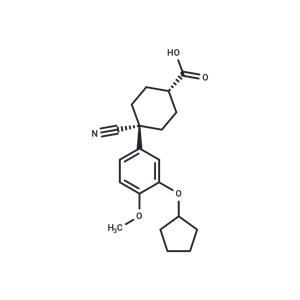
| Name | Cilomilast |
| Description | Cilomilast (SB-207499) is a potent PDE4 inhibitor with an IC50 of approximately 110 nM, demonstrating anti-inflammatory activity and minimal central nervous system effects. Phase 3. |
| Cell Research | U937 cells (1-2 × 10 6) are incubated at 37 °C in a shaking water bath with Cilomilast for 1 min before the addition of 0.1 μM PGE2 (total volume of 200 μL). The incubation proceeds for an additional 4 min and is stopped by the addition of 0.1 mL of HClO4 (17.5%), neutralized with 0.15 ml of K2 |
| In vitro | Cilomilast produces a concentration-dependent increase in cAMP content in U937 cells. Cilomilast produces a concentration-dependent increase in cAMP content in U937 cells. [2] In isolated human monocytes, Cilomilast and (R)-rolipram are equipotent at suppressing LPS-induced TNF-α formation with -log (IC50) of 7.0 and 7.2, respectively. Both Cilomilast and (R)-rolipram produces a modest prevention of fMLP-induced degranulation of human neutrophils. Cilomilast and (R)-rolipram are equipotent at suppressing neutrophil activation with -log (IC50) of 7.1 and 6.4, respectively. [2] Cilomilast significantly decreases the expression of TNF-α in the cornea and IL-1α, IL-1β, and TNF-α in the conjunctivaas compared to vehicle control. Cilomilast treatment markedly decreases the presence of CD11b+ antigen-presenting cells in the central and peripheral cornea, and leads to decreased conjunctival expression of cytokines IL-6, IL-23, and IL-17. Moreover, Cilomilast decreases the expression of IL-17 and IL-23 in the draining lymph nodes. [3] Cilomilast reduces TLR4 expression, IL-8 release and neutrophil chemotactic activity as well as it increased IP-10 release and lymphocyte chemotactic activity. [4] |
| In vivo | Cilomilast inhibits human TNFα production with oral ED50 of 4.9 mg/kg. In contrast to their equipotent activity against TNFα production, Cilomilast (ED50 = 2.3 mg/kg, p.o.) is 10-fold less potent than R-rolipram (ED50 = 0.23 mg/kg, p.o.) in reversing reserpine-induced hypothermia, a model of antidepressant activity. [1] In time course studies, Cilomilast (30 mg/kg, p.o.) suppresses TNFα production for at least 10 hour. The ability of Cilomilast to modulate interleukin-4 productionin vivo is assessed in a chronic oxazolone-induced contact sensitivity model in Balb/c mice. Topical administration of Cilomilast (1000 μg) inhibits intralesional concentrations of interleukin-4. [1] Orally administered cilomilast dose-dependently inhibits production of interleukin-4, TNF-α, and cysteinyl leukotrienes, as well as leukocyte infiltration in bronchoalveolar lavage fluid from the airways of ovalbumin-sensitized Brown Norway rats [5]. |
| Storage | Shipping with blue ice/Shipping at ambient temperature. |
| Solubility Information | Ethanol : 31 mg/mL (90.27 mM), Sonication is recommended.
DMSO : 60 mg/mL (174.71 mM), Sonication is recommended.
10% DMSO+40% PEG300+5% Tween 80+45% Saline : 2 mg/mL (5.82 mM), Sonication is recommended.
H2O : < 1 mg/mL (insoluble or slightly soluble)
|
| Keywords | SB207499 | SB 207499 | pulmonary | Phosphodiesterase (PDE) | phosphodiesterase | PDE4 | obstructive | LPDE4 | Inhibitor | inhibit | immunomodulatory | HPDE4 | disease | COPD | Cilomilast | chronic | asthma | anti-inflammatory |
| Inhibitors Related | Balipodect | Theophylline monohydrate | D(+)-Raffinose pentahydrate | Theobromine | Apremilast | Isoprenaline hydrochloride | Indomethacin | Icariin | Theophylline | Vardenafil hydrochloride | Sildenafil citrate | Doxofylline |
| Related Compound Libraries | Anti-Neurodegenerative Disease Compound Library | Bioactive Compound Library | Drug Repurposing Compound Library | Inhibitor Library | Orally Active Compound Library | Metabolism Compound Library | Anti-Aging Compound Library | Immunology/Inflammation Compound Library | Clinical Compound Library | Bioactive Compounds Library Max | Covalent Inhibitor Library | Human Metabolite Library |


 United States