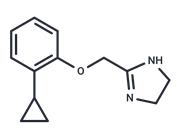
| Name | Cirazoline hydrochloride |
| Description | Cirazoline hydrochloride is a synthetic compound that acts as a competitive full agonist of the α1A-adrenergic receptor (α1A-AR) with a binding affinity of Ki = 120 nM, and Cirazoline hydrochloride also functions as a partial agonist at α1B-AR (Ki = 960 nM) and α1D-AR (Ki = 660 nM), thereby serving as a versatile adrenergic receptor probe with relevance for studying vascular tone regulation, adrenergic pharmacology, and potential therapeutic cardiovascular applications. |
| In vitro | Methods: Glioblastoma-initiating cells were treated with cirazoline hydrochloride (5-10 μM, 24 hours), and cell viability was measured using the WST-1 reduction assay.
Results: Cirazoline hydrochloride did not alter the viability of GICs and only slightly antagonized prazosin-induced GIC death. [2] |
| In vivo | Methods: B6/CBA mice were treated with Cirazoline hydrochloride (drinking water, 40 μM, for 9 months) to investigate the influence of α1A-AR signaling in antidepressant effects.
Results: Wild-type mice with long-term intake of Cirazoline hydrochloride showed a significant reduction in immobility time during the TST (tail suspension test). [1]. |
| Storage | Store at low temperature | Shipping with blue ice/Shipping at ambient temperature. |
| Solubility Information | H2O : 24 mg/mL (94.96 mM), Sonication is recommended.
|
| Keywords | LD-3098 Hydrochloride | Cirazoline Hydrochloride |
| Inhibitors Related | Theophylline monohydrate | Octopamine hydrochloride | Inosine | Dexmedetomidine hydrochloride | Theobromine | Isoprenaline hydrochloride | D-Mannitol | Mianserin hydrochloride | Trazodone hydrochloride | Theophylline | Doxofylline | Doxepin hydrochloride |
| Related Compound Libraries | Bioactive Compound Library | Neuronal Signaling Compound Library | ReFRAME Related Library | Bioactive Compounds Library Max | GPCR Compound Library |



 United States