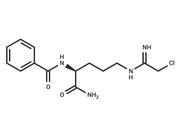
| Name | Cl-amidine TFA |
| Description | Cl-amidine TFA is an orally active PAD inhibitor with IC₅₀ values of 0.8 μM, 6.2 μM and 5.9 μM for PAD1, PAD3 and PAD4, respectively. This compound can induce cancer cell apoptosis, and also upregulate the expression of miR-16 (miRNA-16, microRNA-16), thereby triggering cell cycle arrest. In addition, Cl-amidine TFA can block the citrullination of histone 3 and the formation of neutrophil extracellular traps, effectively improving the survival rate of mice with sepsis. |
| In vitro | Cl-amidine TFA is a bioavailable haloacetamidine-based compound that inhibits all active PAD isozymes with comparable potency, with an inactivation efficiency constant of 13,000 M⁻¹·min⁻¹ for PAD4[1].
When cells are treated with Cl-amidine TFA at concentrations of 0, 5, 10, 15, 20, 25 and 50 μg/mL for 24 hours, it induces apoptosis in TK6 lymphoblastoid cells and HT29 colon cancer cells in a dose-dependent manner; notably, the HT29 colon cancer cell line exhibits relative resistance to apoptosis induced by Cl-amidine[2].
Cl-amidine TFA achieves irreversible inactivation of PADs by covalently modifying the cysteine residue in the PAD active site that is involved in catalytic activity[4]. |
| In vivo | At a dose of 75 mg/kg administered intraperitoneally once daily, Cl-amidine TFA exerts inhibitory and therapeutic effects on dextran sulfate sodium-induced colitis in mice[2].
When administered by oral gavage at doses of 5, 25 and 75 mg/kg once daily, Cl-amidine TFA also significantly reduces the histological scores in a dose-dependent manner[2]. |
| Storage | store under nitrogen | In solvent: -80°C for 1 year | Shipping with blue ice/Shipping at ambient temperature. |
| Keywords | PAD4 | Cl-amidine TFA | Clamidine TFA | Cl amidine TFA |
| Inhibitors Related | Stavudine | Aceglutamide | Urea | Tamoxifen | Cysteamine hydrochloride | Metronidazole | Citric Acid Triammonium | Formamide | Dimethyl phthalate | Alginic acid | Sodium Molybdate | Sildenafil citrate |



 United States